
November 4, 2026
Do You Need Degree to Work in Call Center? What Employers Really Look For
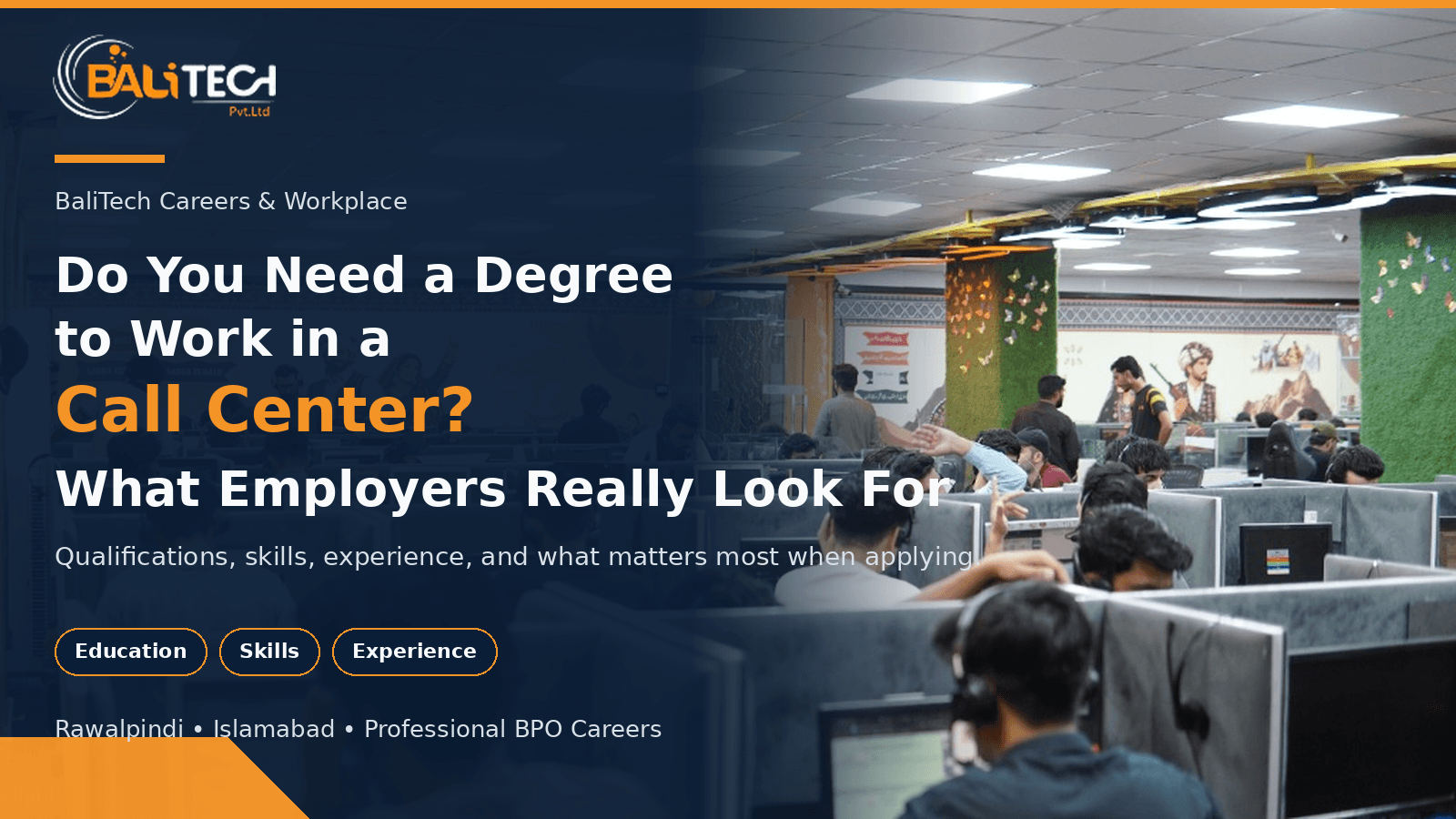
Do you need a university degree to work in a call center? The answer depends on the role. Learn how education, communication, computer confidence, experience, professionalism, and willingness to learn affect call center hiring—and what candidates should check before applying.
One of the first questions many young candidates ask when considering a BPO career is whether they need a university degree before they can work in a call center. It is an understandable concern. Job advertisements often use different wording, one company may ask for previous experience, another may focus on communication, and a third may mention education without clearly explaining how much it matters for the actual role.
The short answer is straightforward: a university degree is not a universal requirement for every call center job. The real call center job requirements depend on the position, campaign, company, customer market, and level of responsibility. Some frontline roles may place greater importance on communication, listening, professionalism, computer confidence, and willingness to learn. Other positions—particularly technical, specialized, quality, training, medical billing, or leadership roles—may require previous experience, additional knowledge, or specific qualifications.
At BaliTech, we do not treat every vacancy as though it is the same job. A verifier, closer, QA professional, trainer, medical billing employee, or technical team member can have very different responsibilities. That is why candidates should always read the current vacancy carefully instead of assuming that one education rule applies to every role in a BPO organization.
Do Call Center Jobs Require a Degree?
No single degree requirement applies to every call center job. Some employers may prefer candidates with a bachelor's degree, while others may accept Intermediate or equivalent education for certain frontline positions. In many customer-facing roles, employers also pay close attention to whether the candidate can communicate clearly, understand instructions, use basic computer systems, behave professionally, and learn the campaign process.
The key point is that education is only one part of employability. A degree may strengthen a candidate's profile, especially for certain professional or specialized roles, but it does not automatically make someone better at customer communication, sales, verification, problem-solving, or handling real conversations. In the same way, not having a university degree does not automatically mean a candidate is unsuitable for every call center position.
Why Call Center Qualifications Vary From One Role to Another
The phrase “call center job” covers many different types of work. That is one reason call center qualifications can vary so much between vacancies. A customer service representative may need strong listening and problem-solving skills. A verifier may need accuracy and the ability to follow a defined process. A closer may need previous sales experience and stronger objection-handling ability. A QA executive may need experience reviewing calls and providing structured feedback.
Technical and specialized positions can be different again. A dialer professional may need practical experience with BPO calling systems. Medical billing work can require familiarity with healthcare workflows, claims, eligibility, or related processes. Trainers and team leaders need the ability to guide other employees, not simply perform the frontline role themselves. Once the responsibilities change, the call center job qualifications can change as well.
This is why candidates should avoid thinking about the industry as one job with one entry requirement. BaliTech's own working environment includes different campaign and professional functions, and current openings can have different experience and skill expectations. Our guide to Verifier, Closer, and CSR Roles in Call Centers explains how even three common customer-facing positions can require different strengths.
Education Matters, but It Is Not the Only Thing Employers Evaluate
Education can tell an employer something about a candidate's academic background, but it does not answer every question about workplace readiness. A recruiter still needs to understand whether the person can communicate, listen, follow instructions, use a computer, handle responsibility, and learn the process connected with the vacancy.
This becomes especially important in international call center jobs. An employee may need to speak with customers while reading information from a screen, updating a CRM, following a script, recording an outcome, and listening carefully enough to respond correctly. Those abilities involve practical skills that cannot be measured only by looking at a degree title.
A strong candidate therefore presents the full picture: education, communication, experience where relevant, computer confidence, reliability, and willingness to learn. The balance between those areas depends on the role.
What Do Employers Look for Beyond a Degree?
There is no universal checklist used by every employer, but several practical qualities appear repeatedly across professional BPO roles. Communication is one of the most obvious because many positions involve customers, colleagues, supervisors, or written information. Listening matters just as much because responding professionally begins with understanding what the other person has actually said.
Basic computer confidence is another important factor. Modern call center work usually involves more than a phone. Employees may work with CRM systems, dialers, customer records, internal tools, scripts, reporting screens, or other digital processes. A candidate does not necessarily need to be a technical expert for a frontline role, but being comfortable learning workplace software can make the transition much easier.
Employers also notice professionalism. Arriving on time, following instructions, communicating respectfully, taking feedback seriously, and being honest about previous experience can matter more than candidates sometimes realize. A person who claims skills they do not have may struggle quickly when the work begins. Someone who is realistic about what they know and willing to learn can be much easier to develop.
Communication Skills Matter in Many Call Center Roles
Communication remains one of the most useful call center skills, but good communication should not be confused with using complicated English or speaking continuously. Professional communication means understanding the conversation, responding clearly, maintaining an appropriate tone, and explaining information without creating unnecessary confusion.
For international campaigns, spoken English can be important, but exact expectations can differ by vacancy. Some roles may require stronger fluency or campaign-specific communication than others. Candidates who are worried that they need to sound completely American or British can read our article Do You Need a Perfect English Accent for a Call Center Job?, where we explain why clarity, listening, comprehension, and professional conversation are often more useful measures than accent alone.
Basic Computer Skills Are More Important Than Many Freshers Expect
A candidate can communicate well and still find the job difficult if they are uncomfortable using basic computer systems. During a live conversation, an employee may need to move between screens, enter information accurately, read customer details, update records, select an outcome, or follow the next step in a digital workflow.
For many frontline positions, this does not mean advanced programming or technical knowledge. It usually means being comfortable with common computer tasks, typing, web-based systems, and learning the software used by the campaign. Specialized technical roles naturally require more.
For someone entering the industry for the first time, improving basic computer confidence before applying can therefore be just as useful as preparing interview answers.
Can You Get a Call Center Job Without a Degree?
Yes, some call center positions may be available to candidates who do not have a university degree, depending on the employer and vacancy. The more useful question is not simply “Can I get a call center job without a degree?” but “What does this particular role require?”
A frontline position may be open to a candidate whose education is below bachelor's level if the person meets the communication, computer, schedule, and role-specific requirements. Another vacancy may prefer or require graduation because the responsibilities are different. A specialized department may need professional knowledge that a basic customer-facing role does not.
Candidates should therefore avoid assuming that either extreme is true. It is inaccurate to say that no call center job requires a degree, and it is equally inaccurate to say that every call center job requires one.
Can Freshers Start a Career in a Call Center?
Yes, some positions can be suitable for fresh candidates, while others require previous campaign or departmental experience. The important thing is to check the vacancy rather than applying to every role in the same way. Call center jobs for freshers usually require candidates to show the basic qualities an employer can evaluate even when there is no previous professional history.
A fresher can demonstrate clear communication, listening, willingness to learn, basic computer confidence, punctuality, professionalism, and a realistic understanding of the job. None of those require someone to pretend they have already spent years in the industry.
At BaliTech, some opportunities can suit people earlier in their careers while other positions specifically require previous experience. Current vacancies should always be checked through the official BaliTech Careers page, because campaign and departmental requirements change according to active hiring needs.
Can You Get a Call Center Job Without Experience?
Just like education, experience requirements vary. Some call center jobs without experience are designed for candidates who can learn the process through onboarding and training. Other roles require previous experience because the company needs someone who can contribute to a live operation with less introductory development.
A closer role, for example, may require previous sales experience because the employee is expected to handle qualified opportunities and objections. A QA position may require previous quality experience because the employee must understand how to review calls and identify issues. A technical role may require experience with systems that a new candidate has never used.
Freshers should therefore target vacancies that genuinely match their background rather than seeing an experience requirement as something to ignore. Applying honestly to the right role usually creates a better start than trying to enter a position that expects skills the candidate has not yet developed.
Degree vs Experience: Which Matters More?
There is no universal winner because the answer changes with the role. For an entry-level frontline position, communication, attitude, computer confidence, and the ability to learn may be especially important. For a senior campaign role, previous results and practical experience may carry much more weight. For a professional or specialist role, education and technical knowledge may become more important again.
A company hiring someone to manage a dialer, train a sales team, review quality, or work in a specialized back-office function is solving a different hiring problem from a company recruiting an entry-level agent. This is why candidates should think about the responsibilities attached to the vacancy rather than treating “degree vs experience” as one general competition.
What About Specialized BPO Roles?
BPO organizations can include many professional functions beyond frontline calling. Quality assurance, training, leadership, recruitment, HR, medical billing, technology, development, reporting, marketing, and operations can all require different combinations of education, experience, and practical skill.
Someone interested in medical billing may benefit from knowledge of healthcare workflows and claims processing. A technical employee may need experience with CRM, dialer, telephony, infrastructure, or software systems. A trainer needs the ability to explain processes clearly, evaluate performance, and coach employees. A QA professional needs to understand quality criteria and identify errors consistently.
This broader structure is important because it shows why there cannot be one universal answer to BPO job requirements. Our article on professional roles at BaliTech beyond calling and sales gives candidates a wider view of the functions that can exist inside a modern BPO organization.
Does a Degree Guarantee Career Growth?
No. A degree can support someone's professional profile, but career growth usually involves more than education alone. Performance, reliability, skill development, communication, attitude, experience, and the needs of the organization can all influence whether someone is ready for greater responsibility.
Someone with strong academic qualifications still needs to learn the actual work. At the same time, someone who starts in a frontline role can continue developing practical skills and become more valuable as their understanding of the operation improves.
At BaliTech, we promote skill development and performance-based growth rather than presenting promotion as something guaranteed after a fixed amount of time. Opportunities depend on performance, ability, organizational requirements, and the availability of suitable roles.
Training Helps Turn Potential Into Workplace Readiness
Employers do not expect every suitable candidate to arrive knowing every detail of a new campaign. That is one reason structured training matters. A candidate may have communication ability and the right attitude but still need to learn the campaign, script, systems, quality expectations, and process before handling live work.
BaliTech's operating model includes campaign-specific onboarding and training before agents begin live volume, followed by supervisor support, QA review, coaching, and reporting. This creates an important distinction: hiring identifies potential and experience, while training helps connect that background with the actual work.
Our guide Before the First Live Call: How Call Center Training Prepares Agents for the Floor explains what happens between selection and the first live customer conversation.
What Should Fresh Candidates Focus On?
Fresh candidates often spend too much time worrying about what they do not have. They may think they need a perfect degree, perfect English, previous campaign experience, or a complicated CV before they can even apply. A better approach is to focus on what can realistically be improved before the interview.
Start with communication. Make sure you can introduce yourself naturally and answer basic questions without relying on a memorized speech. Improve listening. Become comfortable using a computer. Understand what the role actually does. Learn enough about the company and campaign to know what you are applying for. Arrive on time and present yourself professionally.
Those are simple things, but they tell an employer that the candidate is taking the opportunity seriously.
What Should Experienced Candidates Focus On?
Experienced applicants should be more specific. Saying “I have call center experience” is less useful than explaining what the experience involved. A verifier should be able to explain verification responsibilities. A closer should discuss sales conversations and objections. A QA candidate should be able to talk about call reviews, feedback, and quality standards.
Campaign names alone do not prove what someone actually did. Employers want to understand responsibility, performance, and practical knowledge. This becomes increasingly important as candidates move toward roles where previous experience is part of the formal requirement.
How to Read a Call Center Job Description Properly
Before applying, separate the vacancy into a few basic questions. What is the role? Which campaign or department does it belong to? Does it require previous experience? Does it mention a specific qualification? What communication level is expected? Where is the office? What is the shift? Is the role on-site or remote? What responsibilities will you actually perform?
This simple review prevents a common mistake: applying because the title contains the words “call center” without understanding the job. A closer vacancy and a customer support vacancy may exist in the same company but require very different candidates.
Anyone preparing for the recruitment stage can also use our complete call center interview preparation guide to understand introductions, common questions, communication, and practical interview preparation.
Call Center Job Requirements at BaliTech
BaliTech operates different campaign and professional functions, so our hiring requirements depend on the role rather than one universal rule. Some active vacancies focus on good communication skills, while others specifically ask for previous campaign, quality, technical, or departmental experience. This is why candidates should use the live Careers page instead of relying on assumptions or an old job post.
For example, a current campaign role may focus strongly on communication and role-specific experience, while QA, training, dialer, or specialized functions can require a different background. The recruitment team evaluates candidates against the actual responsibility of the position being filled.
Current roles can be reviewed through the official BaliTech Careers page, while candidates who want to become part of the organization can also visit Join Us.
Call Center Jobs in Rawalpindi and Islamabad
Candidates searching for call center jobs in Rawalpindi, BPO jobs Rawalpindi, call center jobs Islamabad, or broader international call center jobs will find vacancies with very different requirements. One position may be suitable for a fresher, another may require one or two years of campaign experience, and another may belong to a professional department where specialist knowledge is expected.
This is why searches such as call center in Rawalpindi or BPO in Rawalpindi should be the beginning of the candidate's research rather than the entire decision. Once a company or role is found, the next step should be understanding what the position actually requires.
BaliTech operates offices across Rawalpindi and Islamabad. Candidates can review branch information through our office locations page and confirm the workplace connected with a current vacancy before applying.
What Does “Best Call Center” Mean When You Are Looking for Your First Job?
Searches such as best call center in Rawalpindi, best call center in Islamabad, and best call center in Pakistan can help candidates discover employers, but the company that appears in a search result is not automatically the right workplace for every person.
For someone entering the industry, a strong opportunity should match their current skills while giving them room to learn. Look at the role, training, shift, supervisor structure, workplace environment, performance expectations, and whether the company clearly explains what it expects from candidates.
Someone with no sales experience may not be suited to an experienced closer vacancy even if they like the company. Someone with strong customer-service skills may be a better fit for another department. The right career decision starts with understanding both the employer and yourself.
What We Look for in People at BaliTech
At BaliTech, different departments require different technical and campaign backgrounds, but professionalism remains important across the organization. We value people who are willing to learn, communicate clearly, take responsibility for their work, listen to feedback, and understand that performance improves through consistent effort.
For fresh candidates, honesty matters. We would rather understand what someone genuinely knows and where they need development than hear an exaggerated version of their experience. For experienced applicants, we want to understand the actual responsibilities they handled, not just the name of the campaign or company where they worked.
Our environment includes training, supervisor support, quality review, skill development initiatives, and performance-based growth. Education can be part of someone's professional foundation, but what they do with their skills and opportunities after joining matters as well.
Frequently Asked Questions About Call Center Job Requirements
Do you need a university degree to work in a call center?
No, a university degree is not a universal requirement for every call center job. Education requirements vary by employer and role. Some frontline positions may accept candidates below bachelor's level, while specialized or professional roles may prefer or require additional education, knowledge, or experience.
What qualifications do you need for a call center job?
Call center qualifications depend on the position. Communication, listening, basic computer confidence, professionalism, and willingness to learn are useful in many frontline roles. Sales, QA, technical, medical billing, training, and leadership positions can require additional experience or specialist knowledge.
Can I work in a call center after Intermediate?
Some call center positions may accept candidates with Intermediate or equivalent education, depending on the employer and vacancy. Candidates should check the actual education and experience requirements before applying because not every role has the same standard.
Can freshers work in a call center?
Yes, some call center jobs are suitable for freshers. Other positions require previous experience. Fresh candidates should focus on communication, listening, basic computer skills, professionalism, and willingness to learn while applying only to vacancies that match their background.
Can I get a call center job without experience?
Some entry-level positions may accept candidates without previous call center experience, especially when training is provided. Specialized, senior, technical, QA, closer, or campaign-specific roles may require prior experience.
What skills do call center employers look for?
Useful call center skills can include clear communication, active listening, computer confidence, accurate documentation, professionalism, customer handling, reliability, and the ability to learn a campaign process. The exact skills depend on the role.
Is English required for call center jobs?
Language requirements depend on the customers and campaign. International voice roles commonly require clear spoken English and good comprehension, while other operations may have different language requirements. Candidates should always check the vacancy.
Does experience matter more than education in a call center?
It depends on the role. Practical experience may matter strongly for campaign, sales, QA, technical, or leadership positions, while education may matter more in some professional or specialized functions. Employers usually evaluate the combination that best matches the job.
Does BaliTech hire freshers?
Some BaliTech opportunities may suit fresh candidates while other positions require previous experience. Requirements depend on the active vacancy, so applicants should review the live Careers page before applying.
Does BaliTech require a degree for every job?
No single qualification rule should be assumed for every BaliTech position. Different campaign, technical, quality, training, and professional roles have different requirements. Candidates should review the education, experience, and skill requirements of the specific vacancy.
Where can I see current BaliTech job requirements?
Current vacancies and role details are published through the official BaliTech Careers page. Candidates can also use Join Us to review opportunities and submit their information.
The Real Requirement Is Being Ready for the Role
A degree can be valuable, and education should never be dismissed. But when people ask whether they need a degree to work in a call center, the most accurate answer is that the requirement depends on the job. Modern BPO organizations include entry-level customer-facing positions, experienced campaign roles, quality teams, trainers, technical departments, medical billing professionals, managers, and many other functions. One education rule cannot realistically cover all of them.
For candidates, the best approach is to understand the actual vacancy. If a role accepts freshers, focus on communication, computer confidence, professionalism, and willingness to learn. If it requires experience, be ready to explain what you genuinely did in your previous position. If it is a specialist role, make sure your education, knowledge, or practical background matches the responsibilities.
At BaliTech, we encourage candidates to apply based on the role that matches their current skills and experience rather than assuming that one qualification defines an entire BPO career. The industry can offer opportunities to people entering professional work as well as experienced specialists, but the right starting point will be different for each person. To see what is currently available across our Rawalpindi and Islamabad offices, visit the BaliTech Careers page and review the requirements of the role before applying.