
November 2, 2026
Before the First Live Call, How Call Center Training Prepares Agents for the Floor
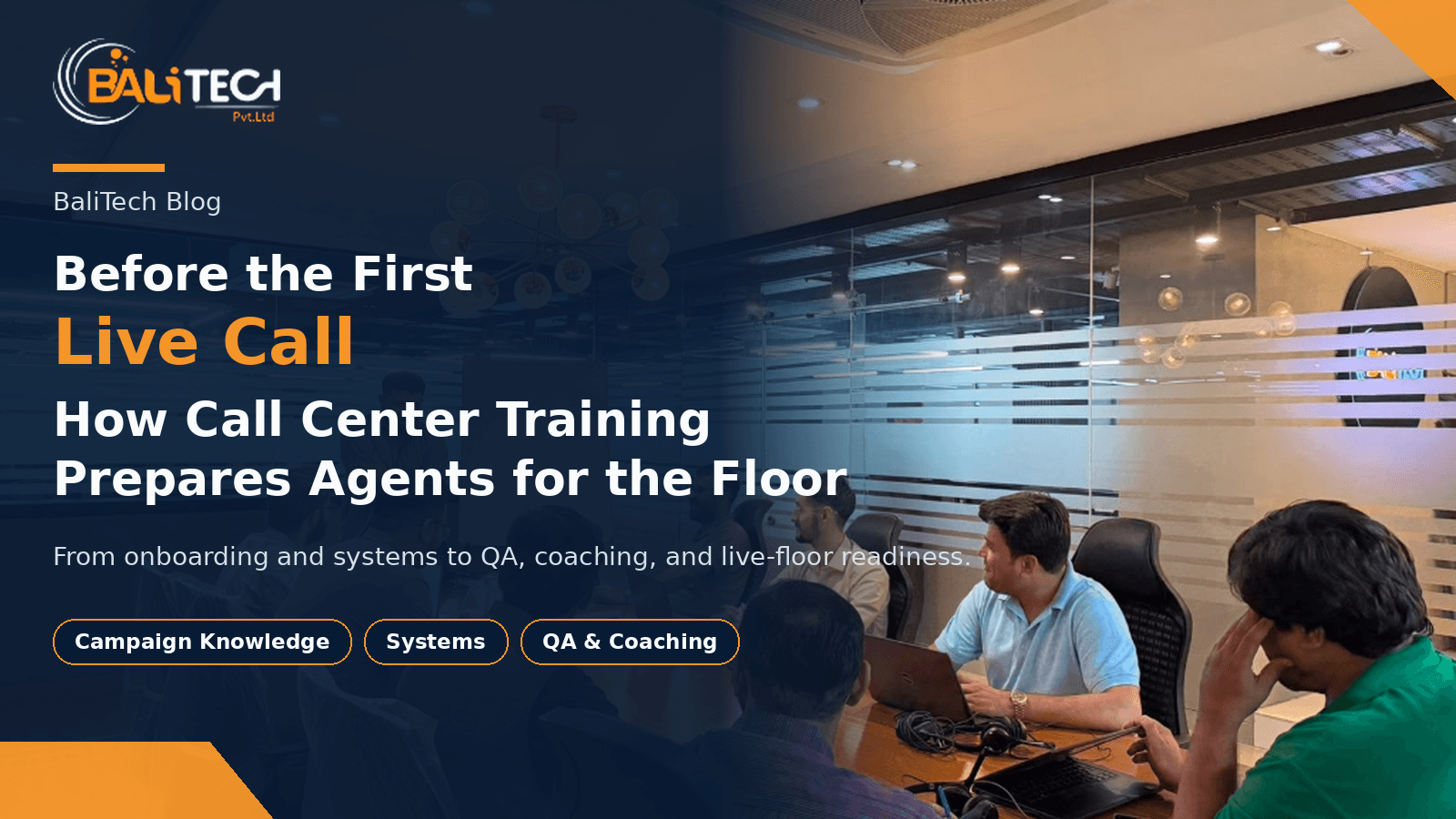
What happens between getting hired and taking the first live customer call? This guide explains how call center training builds campaign knowledge, communication, system understanding, quality awareness, and live-floor readiness before agents begin handling real conversations.
Getting hired for a call center role is only the beginning. Before an agent is ready to speak with a real customer, there is another important stage between recruitment and the live floor call center training. A professional call center training program is not simply about memorizing a script or learning how to answer a phone. It is about understanding the campaign, knowing what the customer interaction is supposed to achieve, learning the systems used during the conversation, understanding quality expectations, and becoming comfortable enough with the process to handle live work responsibly.
At BaliTech, training sits inside a wider operating process rather than being treated as a one-time classroom activity. Our public operating model follows a structured path from discovery and team building to training, launch, and ongoing optimization. Agents complete campaign-specific onboarding and product training before they begin handling live volume, and the live stage continues with supervisor oversight, quality reviews, coaching, and reporting. That distinction matters because good call center agent training should prepare someone for the first call, while ongoing coaching helps improve performance after real calls begin.
What Is Call Center Training?
Call center training is the process of preparing an agent to handle the responsibilities of a specific customer, campaign, or operation before beginning live work. It can include campaign knowledge, scripts, communication standards, CRM or ticketing systems, calling tools, quality criteria, escalation procedures, documentation requirements, and the practical flow of a customer interaction.
The exact training content should depend on the work. An outbound sales campaign does not create the same conversations as inbound customer support. A verifier may need to focus heavily on accuracy and required questions, while a closer may need stronger objection-handling and campaign knowledge. A CSR may spend more time learning customer-service processes and how to respond to different types of requests. That is why effective BPO training should be connected to the actual role rather than treating every new employee as though they will perform the same job.
What Happens After a Call Center Agent Is Hired?
After recruitment, a new employee needs to understand where their role fits into the wider operation. Knowing the job title is not enough. An agent needs to understand what the campaign is trying to accomplish, who they will speak with, what information matters during the interaction, what they are allowed to say, what they should record, and what should happen when a conversation does not follow the expected path.
This is where call center onboarding becomes important. Onboarding introduces the working environment, but role-specific training goes deeper. It connects the employee with the campaign process they will actually use. BaliTech’s operating model reflects this separation clearly: the team is first structured around the campaign, then agents complete campaign-specific training before live work begins. That prevents the training process from becoming a generic introduction that has little connection with what agents will face on the floor.
Agents Need to Understand the Campaign Before They Memorize the Script
A script makes more sense when the agent understands the reason behind it. If someone memorizes every line without understanding the campaign, a simple unexpected customer question can break the conversation. The employee may know what sentence comes next but not understand why it is being said or what should happen when the customer responds differently.
Campaign knowledge gives the script context. A new agent should understand the purpose of the interaction, the basic customer journey, important campaign terms, required information, common questions, and the point at which an issue should be escalated or transferred. For teams working across different US campaigns, this becomes particularly important because the workflow can change from one campaign to another. Readers who want to understand those differences can explore our guide to campaigns at BaliTech, including Medicare, ACA, Final Expense and other operations.
Call Center Scripts Are a Framework, Not the Entire Conversation
Call center scripts can provide consistency. They help define important questions, required statements, call flow, and information that should not be missed. In regulated or structured campaign environments, script adherence can also be connected with compliance and quality standards. But memorizing the words is not the same as learning how to communicate.
A live conversation rarely behaves exactly like a training document. Customers interrupt, ask questions, speak at different speeds, misunderstand information, or move the conversation in an unexpected direction. Training therefore has to help agents understand how to use the script while still listening to the person on the other side. The agent needs to know which parts of the process must remain consistent and where natural communication is possible without changing the required message.
Communication Training Is About More Than Accent
Communication is one of the most visible parts of call center work, especially on international campaigns, but good call center communication skills involve much more than sounding American or British. An employee needs to speak clearly, understand questions, listen without interrupting, explain information in simple language, maintain a professional tone, and respond naturally when the conversation moves away from the expected script.
This is why communication training should focus on being understandable and effective rather than simply trying to copy someone else's accent. Different campaigns can still have different spoken-English expectations, but clarity, listening, comprehension, pronunciation, and professional conversation remain important across many roles. We discussed this in detail in our article Do You Need a Perfect English Accent for a Call Center Job?, which explains what candidates should actually focus on when preparing for international call center work.
Learning the CRM, Dialer, and Other Systems Before Live Work
Modern call center work involves more than speaking. During the same conversation, an agent may need to view customer information, update a CRM, select a disposition, record an outcome, schedule a callback, follow a workflow, or move the interaction to the next stage. Knowing what to say while not knowing how to use the system can create problems just as easily as poor communication.
That is why a complete call center training program should connect system training with the business process. An employee should understand not only where to click but why that information is being entered and what happens after the record is updated. BaliTech’s inbound operating model states that agents are trained on scripts, systems, and quality criteria before go-live, including the CRM and ticketing tools required for the operation. Readers interested in the systems behind modern campaigns can also explore how call center technology supports modern BPO operations.
Why Practice Matters Before the First Live Customer
Knowing something in theory and using it during a real conversation are different skills. An employee may understand the campaign during training but still need practice combining several things at once: listening, speaking, following the process, using the system, recording the right information, and maintaining the correct tone.
That is why practical training activities can be useful before live work. Depending on the company and campaign, training may include guided scenarios, role-play, practice conversations, example calls, system exercises, or other controlled ways of helping employees understand how the process feels in real time. The exact method will vary, but the objective is the same: reduce the gap between knowing the process and being able to perform it during a live interaction.
Quality Standards Should Be Introduced Before the Floor
Quality assurance should not appear for the first time after an agent receives a low score. If employees are going to be evaluated on particular standards, those standards should be understandable before live work begins. A new agent should know what the operation considers a good interaction, which steps are important, what information must be recorded, and which mistakes can create larger problems.
This is where call center quality assurance connects directly with training. QA gives the operation a way to review whether real interactions are meeting the expected standard, but training gives agents an opportunity to understand that standard before they are measured against it. BaliTech’s quality model includes call monitoring, scorecard-based feedback, and structured reviews around campaign expectations. Our separate article on how BaliTech maintains quality across call center operations explains how monitoring, supervision, reporting, and feedback work together after campaigns go live.
What Should a New Agent Know Before Going Live?
There is no single checklist that applies to every call center campaign, but an agent should normally understand the main parts of the role before handling live volume. That means knowing the purpose of the campaign, the expected call or customer flow, the important script or process requirements, the systems being used, the information that needs to be recorded, the quality expectations, and what to do when the normal process cannot continue.
Readiness is also practical. An employee may understand all the information in a training session but still need more confidence using it together. A professional training environment should therefore look at whether the employee can apply what they have learned, not simply whether they attended the required sessions. The purpose of training is not to finish training. The purpose is to prepare someone to work responsibly on the live floor.
When Is an Agent Ready for the First Live Call?
There is no universal number of hours or days that makes every agent ready. Training length can change according to the complexity of the campaign, the role, the systems being used, previous experience, customer requirements, and the amount of information an employee needs to understand before go-live. A simple process may require less preparation than a campaign with detailed scripts, multiple systems, or strict quality requirements.
The better question is whether the agent understands enough of the process to perform the role under the supervision available during the launch stage. BaliTech’s operating model places launch after training, with supervisor oversight and daily monitoring during the ramp-up period. That sequence is important because training does not need to create a perfect employee before the first call. It needs to create a prepared employee who can enter live work with the right foundation and continue improving under real operational support.
Training Does Not End When Live Calls Begin
The first live call is not graduation from learning. Real customer conversations expose situations that classroom training cannot always predict. An agent may discover that a certain question is harder to explain than expected, that customers regularly respond in a different way, or that using the CRM during a fast conversation requires more practice. Supervisors and quality teams begin seeing patterns that were impossible to see before live volume existed.
This is where call center coaching becomes different from initial training. Training gives the employee the knowledge and process needed to begin. Coaching uses real performance to improve specific behaviors after work has started. At BaliTech, the operating cycle continues after launch through QA reviews, coaching, reporting, and optimization rather than treating training as a one-time event that ends when an employee reaches the floor.
Training, Coaching, and QA Are Different Parts of the Same Development Process
These three terms are sometimes used as though they mean the same thing, but they serve different purposes. Training generally teaches the knowledge, process, and tools needed for the role. QA reviews actual work against defined quality criteria. Coaching uses what the operation learns from performance to help an employee improve a specific behavior, skill, or part of the process.
A strong operation needs all three to connect. Training without QA can make it difficult to know whether the lessons are being applied. QA without coaching can create scores without improvement. Coaching without proper training can become an attempt to repair gaps that should have been addressed before the employee started live work. When these functions support each other, the operation can identify whether a problem comes from knowledge, individual performance, scripting, technology, or the wider process.
Training Changes According to the Role
Training for call center agents should not look identical across every position. A CSR needs to understand the customer-service process and how to respond to different requests. A verifier may need deeper attention to required questions, confirmation language, and accurate information. A closer may spend more time developing campaign knowledge, sales conversations, objection handling, and the later stage of a qualified opportunity.
That difference is one reason job seekers should understand the role before applying. Our guide to Verifier, Closer, and CSR Roles in Call Centers explains how those responsibilities differ and why experience in one role does not automatically mean someone has performed the same work as another.
Training Also Changes From One Campaign to Another
Even when two employees have the same job title, their training may not be identical if they are working on different campaigns. Campaign terminology, scripts, customer expectations, systems, compliance requirements, call flow, and escalation processes can all change. Someone moving from one campaign to another may therefore bring useful call center experience while still needing new campaign-specific preparation.
This is particularly relevant in BPO environments where teams may support different customer programs. At BaliTech, our operating model emphasizes campaign-specific onboarding because training has to match the work the team is expected to perform. The goal is not simply to produce someone who understands call centers. The goal is to prepare someone who understands the campaign they are about to handle.
What Role Do Supervisors Play During Go-Live?
The transition from training to live work is easier when agents know who is responsible for the operation around them. A supervisor can help manage escalation, observe performance, identify where someone is struggling, and make sure problems are noticed early during the ramp-up period rather than becoming normal habits.
BaliTech’s inbound operating model assigns a named supervisor when a team goes live, while the wider company process describes supervisor oversight and daily monitoring during launch. This is important because the first period of live activity is where training meets reality. A good operating structure does not simply tell agents to begin taking calls and assume the preparation stage is finished.
How Reporting Improves Training Over Time
Training itself can improve when operations teams look at what happens after launch. If several agents repeatedly misunderstand the same part of a script, that may be a training problem rather than an individual problem. If a system step causes repeated errors, the process may need clarification. If customers regularly ask a question that training barely covered, future onboarding can spend more time on it.
Reporting, QA, and supervisor feedback therefore create a loop back into training. This is one reason BaliTech’s operating model ends with optimization rather than stopping at launch. The operation generates information, the team reviews that information, and the process can be refined as the campaign matures. Training becomes stronger when it learns from what actually happens on the floor.
Call Center Training in Rawalpindi and Islamabad
People searching for call center training in Rawalpindi, a call center in Rawalpindi, or a BPO in Rawalpindi are often interested in more than just finding a vacancy. They may want to know whether the company provides enough preparation for someone to understand the role, especially when the work involves international customers, unfamiliar systems, or a campaign they have not handled before.
The same applies to candidates comparing call center opportunities in Islamabad. Training quality can affect how confidently a person enters the role and how clearly they understand expectations from the beginning. BaliTech operates physical offices across Rawalpindi and Islamabad, and our current vacancies are published through the official BaliTech Careers page. Candidates should always review the actual vacancy because the campaign, experience requirements, and available positions can change.
What Should Candidates Look for in a Call Center Training Environment?
Searches such as best call center in Rawalpindi, best call center in Islamabad, and best call center in Pakistan are common because candidates want to compare employers. But a company should not be judged only by a name, salary figure, campaign label, or social media post. The way employees are prepared for the work is another useful thing to understand.
Candidates can look at whether training is connected to the actual role, whether systems and process expectations are explained before live work, whether quality standards are clear, and whether supervisors and feedback remain available after launch. No training program can remove every challenge from a new role, but structured preparation gives employees a clearer understanding of what the company expects and how the work is supposed to be performed.
How Call Center Training Fits Into BaliTech's Operating Process
At BaliTech, training is one stage within a larger operating framework. The process begins by understanding the campaign goals, audience, compliance needs, and success measures. The team structure and processes are then built around those requirements. Training follows so agents can learn the campaign and product before handling live volume. After that, the team launches under supervision, and performance continues to develop through QA reviews, coaching, reporting, and operational adjustments.
This approach reflects a broader principle in our working model: people need a clear process around them. Giving an employee a headset, CRM login, and script does not automatically make the person ready for live work. The tools matter, but they become useful when the employee understands the campaign, the conversation, the system, the quality standard, and the support structure around the role.
From Interview to Training to the Live Floor
For job seekers, the journey usually begins before training. First comes understanding the vacancy, preparing for the interview, and making sure the role matches the candidate's experience and communication level. Once someone is selected, the focus changes from getting the job to learning how to perform it correctly.
Candidates who are still preparing for that earlier stage can read our complete call center interview preparation guide. Once hired, the objective changes. The question is no longer “How do I get selected?” but “How do I become ready to handle a real conversation?” That is the purpose of structured onboarding and training.
Frequently Asked Questions About Call Center Training
What is call center training?
Call center training is the preparation agents receive before and during their work so they can understand the campaign, customer process, scripts, systems, communication standards, quality requirements, and role responsibilities. Initial training prepares employees for live work, while coaching and QA continue after launch.
What happens during call center agent training?
Training can include campaign knowledge, script understanding, customer scenarios, communication, CRM or ticketing systems, calling tools, documentation, quality criteria, escalation procedures, and practical preparation for the type of conversations the employee will handle. The exact content depends on the company and campaign.
What is call center onboarding?
Call center onboarding introduces a new employee to the organization and role, while campaign-specific training prepares that person for the actual work. In practice, the two can overlap, but training normally goes deeper into the process, tools, scripts, and standards the employee will use on the floor.
Do call centers train agents before live calls?
Professional call center operations should prepare agents before they begin handling live customer volume. The amount and type of preparation varies according to the campaign. BaliTech's operating model places campaign-specific onboarding and product training before live volume.
How long does call center training take?
There is no universal duration. Training length depends on the campaign, role, systems, complexity of the process, customer requirements, and the employee's previous experience. A simple role may require less preparation than a complex campaign with detailed quality or compliance requirements.
Are mock calls part of call center training?
Practice conversations and role-play can be useful training methods because they allow employees to apply campaign knowledge before speaking with real customers. Whether mock calls are used, and how they are structured, depends on the company and campaign.
What is the difference between call center training and coaching?
Training primarily teaches the knowledge, process, and tools required for the role. Coaching usually happens around actual performance and focuses on improving specific behaviors or skills. Training prepares an employee to begin; coaching helps that employee continue improving.
How does quality assurance connect with training?
Quality assurance reviews live work against defined standards. The patterns found through QA can show where an individual needs coaching or where the wider training process needs improvement. Training, QA, and coaching are therefore closely connected even though they perform different functions.
Do freshers receive call center training?
Training depends on the vacancy and company. Fresh candidates may receive role-specific preparation when the position accepts people without previous experience, while experienced candidates can still need training when joining a new campaign because scripts, systems, processes, and quality expectations can differ.
What should an agent know before the first live call?
An agent should understand the basic campaign purpose, customer process, required script or conversation flow, systems being used, documentation expectations, important quality standards, and how to get help or escalate when the normal process cannot continue.
Does BaliTech provide training before agents handle live volume?
Yes. BaliTech's public operating model states that agents complete campaign-specific onboarding and product training before handling live volume. The launch stage then continues with supervisor oversight, followed by QA reviews, coaching, reporting, and ongoing performance improvement.
Where can I find current call center jobs at BaliTech?
Current openings are published through the official BaliTech Careers page. Candidates can also visit Join Us to review opportunities and submit their information. Because openings change according to operational requirements, candidates should use the live pages rather than relying on an older vacancy.
Good Training Begins Before the First Call and Continues After It
The first live call should not be the first time an employee truly understands the job. Before that moment, the agent should have a working understanding of the campaign, the script or process, the systems, the communication standard, the quality expectations, and the support available when something does not go according to plan. That foundation is what turns call center training from a basic orientation into part of the operation itself.
At BaliTech, the training stage sits between building the campaign team and launching live volume, while supervision, QA, coaching, and reporting continue after go-live. That reflects how professional BPO work develops in practice: people learn the process, apply it on the floor, receive feedback from real performance, and continue improving as the campaign matures. For candidates considering opportunities across our Rawalpindi and Islamabad offices, current roles and requirements can be reviewed through the BaliTech Careers page.