
October 19, 2026
How BaliTech Maintains Quality Across Call Center Operations
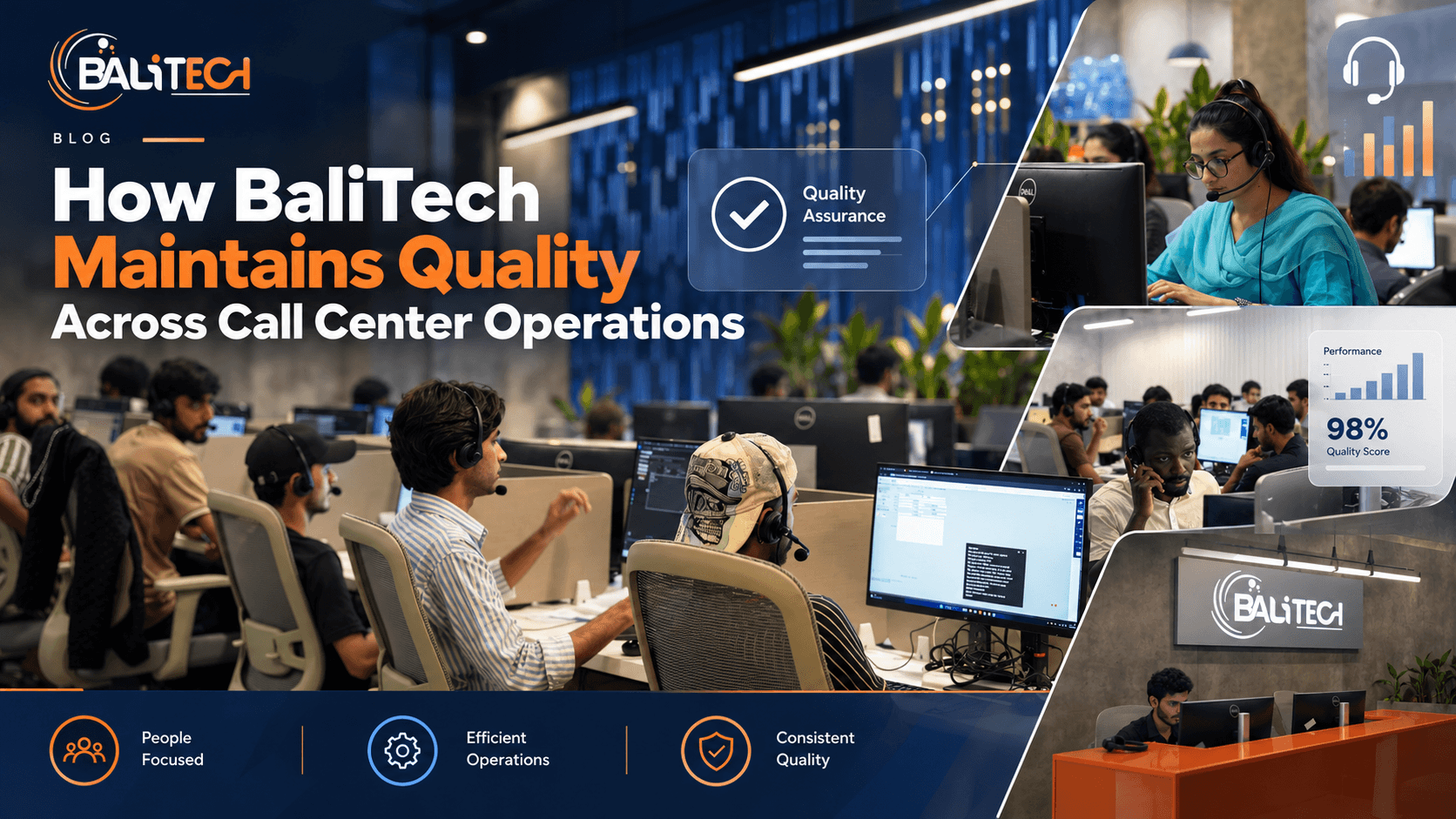
Quality at BaliTech is supported by call monitoring, QA reviews, supervision, reporting and structured feedback. See how these parts work together across our call center operations in Rawalpindi and Islamabad.
Quality in a call center is easy to talk about and much harder to maintain consistently. A professional conversation depends on more than an agent sounding confident on the phone. The right process has to be followed, information has to be recorded accurately, campaign requirements need to be respected, and the people responsible for the operation need enough visibility to know when something is going well or when it needs attention.
At BaliTech, quality assurance is part of the operating structure around our call center and BPO teams. Call monitoring, quality review, supervision, reporting and feedback all help us understand the work being done across active operations. Our teams work across Rawalpindi and Islamabad, and the goal is not to treat quality as a separate activity that happens after the work is finished. It has to remain connected with the people, processes and responsibilities involved in the work every day.
Quality Starts With Clear Expectations
People cannot work consistently when the expected standard is unclear. Before quality can be reviewed, the team needs to understand the process it is expected to follow. That can include the purpose of the campaign, the information that must be captured, the way a conversation should be handled, escalation requirements and any scripts or verification steps connected with the work.
This is especially important because BaliTech operates across different types of BPO and call center work. Our services include inbound and outbound calling, customer support, lead generation, sales and verification, medical billing support and other business processes. The quality requirements are not identical across every team, so the review process needs to stay connected with the actual responsibilities of the operation.
Call Monitoring Gives Quality Teams a View of the Real Work
A performance report can show numbers, but it cannot always explain what happened during an actual conversation. Call monitoring adds that missing context. By reviewing live or recorded interactions where applicable, quality teams can look at how the process was followed, how clearly information was communicated and whether the interaction met the standards attached to the campaign.
Our inbound call center operations, for example, include call quality monitoring alongside customer enquiry handling, account support and escalation routing. This means the quality conversation is connected with the actual customer interaction rather than being judged only from the final outcome.
Quality Is More Than Listening for Mistakes
Reviewing a call should not become an exercise in finding something wrong for the sake of it. A useful quality review should help distinguish between an isolated issue and a repeated pattern. It can also show where an employee is handling a part of the process well and where more clarity or support may be needed.
That makes call monitoring useful to both quality teams and operations leadership. A single review may help improve one interaction, while several reviews can reveal a wider issue with communication, process understanding or a particular stage of the campaign.
Quality Assurance and Operations Need to Work Together
QA cannot maintain standards from a distance. The quality team may review interactions and identify issues, but supervisors and operational leaders are closer to the day-to-day performance of the team. When those functions work together, quality findings become more useful because they can be connected with what is actually happening on the floor.
At BaliTech, our operating structure includes dedicated management, quality assurance and reporting around active service teams. That structure helps keep responsibility clear. QA can identify what it sees in reviewed work, supervisors can understand the operational context, and employees can receive feedback that is connected with their actual responsibilities.
Supervisors Add Context to Quality Findings
A supervisor may know that an employee is new to a process, that a campaign requirement has recently changed or that a particular issue is appearing across several people rather than one individual. That context matters. It helps separate a personal performance issue from something that may require wider clarification or team-level support.
This is one reason quality assurance works better when it is part of the operation rather than treated as an isolated department. The purpose is not simply to produce a score. It is to help the wider team understand whether the work is being handled consistently.
Verification Work Requires Accuracy as Well as Communication
Some call center roles place a particularly strong emphasis on following defined steps accurately. Our sales and verification operations include documented verification requirements, approved scripts, audit trails and quality review. In this type of work, a confident conversation is not enough if an important step has been missed.
This is where quality assurance becomes closely connected with process discipline. A verifier needs to understand what must be asked, what must be recorded and what cannot simply be changed because a conversation is moving quickly. Quality reviewers then provide another layer of checking so issues can be identified through the review process.
Script Adherence Has a Practical Purpose
Scripts are sometimes misunderstood as something designed to make every person sound identical. In verification work, their purpose can be much more practical. Certain information may need to be communicated clearly and consistently, and the quality review needs an agreed standard against which the interaction can be checked.
That does not remove the need for professional communication. Employees still need to listen, speak clearly and understand the conversation. The process simply gives them boundaries that should not be ignored when accuracy matters.
Reporting Helps Quality Become Visible
Call reviews provide detail, while reporting helps teams see patterns. Together they give management a more complete view of performance. BaliTech’s operating model includes reporting alongside management and QA so that campaign activity can be reviewed through agreed measurements rather than relying only on what the floor appears to look like during a busy shift.
Useful reporting can help identify changes that deserve attention. A team may be handling a similar amount of activity while quality results begin to move in another direction. Another team may show an improvement after feedback or a process change. The value is not in producing more reports; it is in making the information useful to the people responsible for the work.
Numbers Need Context
A number by itself rarely explains the whole situation. Quality information becomes more useful when managers can connect it with call reviews, operational observations and the requirements of the campaign. That is why we do not treat reporting and QA as completely separate subjects.
The same principle applies to individual employees. A quality score can indicate that something needs attention, but the review behind that score should help explain what happened and what can be improved.
Feedback Is Where Quality Review Becomes Useful
Monitoring an interaction has limited value if the person doing the work never understands what was found. Feedback closes that gap. It gives an employee a clearer view of where their work matched expectations and where a change may be needed.
At BaliTech, quality and performance are connected with the wider professional environment around our teams. Useful feedback should be specific enough to act on. Telling someone to “communicate better” is less helpful than explaining where the conversation became unclear, which step was missed or how the process should have been handled differently.
Feedback Should Lead to Better Consistency
The purpose of feedback is not to make one call look better after it has already happened. The real value appears when the employee understands the issue well enough to handle the next similar situation more consistently.
This is also why quality improvement takes time. One review can identify an issue, but continued performance shows whether the employee has actually understood and applied the feedback.
Quality Standards Can Differ Across Different Types of Work
BaliTech operates across several service areas, which means a single quality checklist would not make sense for everything. An inbound customer-support interaction has different priorities from an outbound sales conversation. Verification work places more emphasis on process adherence, while medical billing support involves another type of accuracy and administrative responsibility.
The common principle is that quality needs to reflect the work being performed. The standards should help answer a simple question: was this responsibility handled in the way the process required? Keeping that connection prevents quality assurance from becoming a generic exercise that ignores the realities of the team being reviewed.
Inbound Quality Focuses on the Customer Interaction
In inbound and customer-support work, quality may involve listening, accuracy, escalation, process knowledge and how clearly the employee handled the customer’s issue. Our customer support operations are supported by defined processes and team supervision, giving employees a clearer framework for handling different types of conversations.
Outbound Quality Needs Process Discipline
Outbound operations have their own expectations. Teams may work with campaign scripts, qualification requirements, dispositions, callbacks and other steps that need to be recorded consistently. Quality therefore involves both how the conversation was handled and whether the underlying process was followed correctly.
Technology Supports Quality, but People Still Make the Judgement
Call center quality assurance depends on access to reliable information. Recorded interactions, CRM activity, reporting and operational systems can give quality teams the material they need to review what happened. Technology makes that work easier to organize, but the presence of software does not automatically create good quality assurance.
Human judgement still matters because context matters. A system can show that an event occurred, but a quality professional still needs to understand whether the interaction met the expected standard and why. Readers interested in the technical side of our operation can explore how technology supports modern BPO operations at BaliTech.
Quality Is Also a Leadership Responsibility
It would be easy to describe quality as something owned entirely by the QA department. In practice, supervisors, team leaders and managers also influence the standard of work. They set expectations during the shift, respond when a problem appears and help ensure that feedback is not forgotten once the quality review is complete.
This matters in a larger organization because a standard is only useful when people apply it consistently. Leadership helps connect the formal review process with daily behaviour on the floor. QA may identify the pattern, but operational leadership helps make sure the response reaches the team.
Professional Communication Remains Part of Quality
Scripts, systems and scorecards matter, but the person on the call still represents the operation. Clear communication, listening and professional behaviour remain important across customer support, sales, verification and other call-based work. These qualities cannot be separated completely from the process because the customer or prospect experiences both at the same time.
An employee can follow every technical step and still create a poor interaction if they do not listen properly. The reverse is also true: someone may communicate confidently while missing an important process requirement. Strong quality depends on both sides coming together.
Consistency Matters Across a Large BPO Environment
BaliTech operates with more than 900 professionals across four offices in Rawalpindi and Islamabad. In an organization of that size, quality cannot depend on one person personally watching every interaction or remembering every issue. Defined processes, supervisors, QA review and reporting help create a structure that can work across different teams and locations.
This does not mean every floor or campaign should be treated exactly the same. It means the responsibility for quality needs to remain visible even when the work itself differs. Our Rawalpindi and Islamabad offices support different teams within the same wider organization, making consistency and clear responsibility important parts of the working environment.
Quality Assurance Creates Professional Roles of Its Own
QA is also a professional career path within the wider BPO environment. A quality professional needs attention to detail, communication skills and the ability to understand the process being reviewed. They also need enough judgement to explain an issue clearly rather than simply marking something wrong.
When quality or related roles are available at BaliTech, candidates interested in QA jobs in Rawalpindi or other BPO opportunities can review the latest vacancies through our Careers section. Because hiring requirements change, we only treat a role as open when it is currently listed.
Quality Matters When People Compare Call Centers in Rawalpindi
People searching for the best call center in Rawalpindi, best call center in Islamabad or best call center in Pakistan often see similar claims from different organizations. A stronger comparison looks past the label and asks what actually supports the operation. Quality assurance is one of those areas because it shows whether the company has a process for reviewing the work instead of relying only on output numbers.
The same applies when someone searches for a call center in Rawalpindi, call center in Islamabad, BPO in Rawalpindi or BPO in Islamabad. Office size and employee numbers can tell part of the story, but quality structure, supervision, reporting and accountability give a clearer picture of how professionally the work is managed.
What Quality Assurance Means at BaliTech
For us, call center quality assurance is not one person listening to calls after the shift and assigning scores. It is the connection between clear expectations, real interaction review, supervision, reporting, feedback and the responsibility to correct problems when they appear.
That structure also keeps quality connected with the real work. Inbound support, outbound sales and verification do not all need identical review criteria, but each team needs to understand the standard attached to its responsibilities. The purpose of QA is to make that standard visible and help the operation maintain it more consistently.
Frequently Asked Questions About Quality Assurance at BaliTech
Does BaliTech have a quality assurance team?
Yes. Quality assurance is part of BaliTech’s operating structure and supports active call center and BPO teams through monitoring, review and performance feedback. QA works alongside supervisors, management and reporting rather than operating completely separately from the floor.
Does BaliTech monitor calls?
Yes. Call quality monitoring is part of our inbound operating model, and quality review is also used within sales and verification work. The exact review criteria depend on the responsibilities and requirements of the campaign.
How does BaliTech review call quality?
Quality review is based on the standards connected with the specific operation. This can include reviewing interactions, checking process adherence and using quality findings alongside supervision and reporting to understand where performance is consistent or where improvement is needed.
Does BaliTech use quality scorecards?
Our inbound service structure includes calls being monitored and scored against agreed criteria, with quality information included in reporting. The exact criteria can differ according to the campaign and type of work.
How does BaliTech maintain quality in verification calls?
Our sales and verification work includes approved scripts, documented outcomes, audit trails and a quality review process. These controls help keep verification work connected with the steps and standards required for the campaign.
What role do supervisors play in call quality?
Supervisors connect quality findings with daily operations. They understand what is happening on the floor, help employees apply feedback and respond when an issue affects more than one interaction or team member.
Does technology support BaliTech’s QA process?
Yes. Call center technology supports access to interactions, CRM information, reporting and other operational data that quality and management teams use to understand performance. Technology supports the review process, while people remain responsible for interpreting the work and taking action.
Can I apply for a QA job at BaliTech?
QA opportunities depend on current hiring needs. If a quality assurance position is open, it will be listed in our Careers section with the relevant role and application information.
Maintaining Quality Is Part of Maintaining the BaliTech Standard
Call center quality is built through repeated everyday decisions. Employees need to understand the process, supervisors need visibility into the floor, QA teams need access to real interactions, and feedback needs to lead to something useful. Reporting then gives the wider operation a way to see whether those efforts are producing consistent work.
At BaliTech, these responsibilities sit alongside the people and teams running our call center and BPO operations across Rawalpindi and Islamabad. Quality assurance does not replace professional people or strong leadership; it helps both work with a clearer standard. That is the role QA plays within the BaliTech environment today.