October 5, 2026
How Call Center Technology Supports Modern BPO Operations
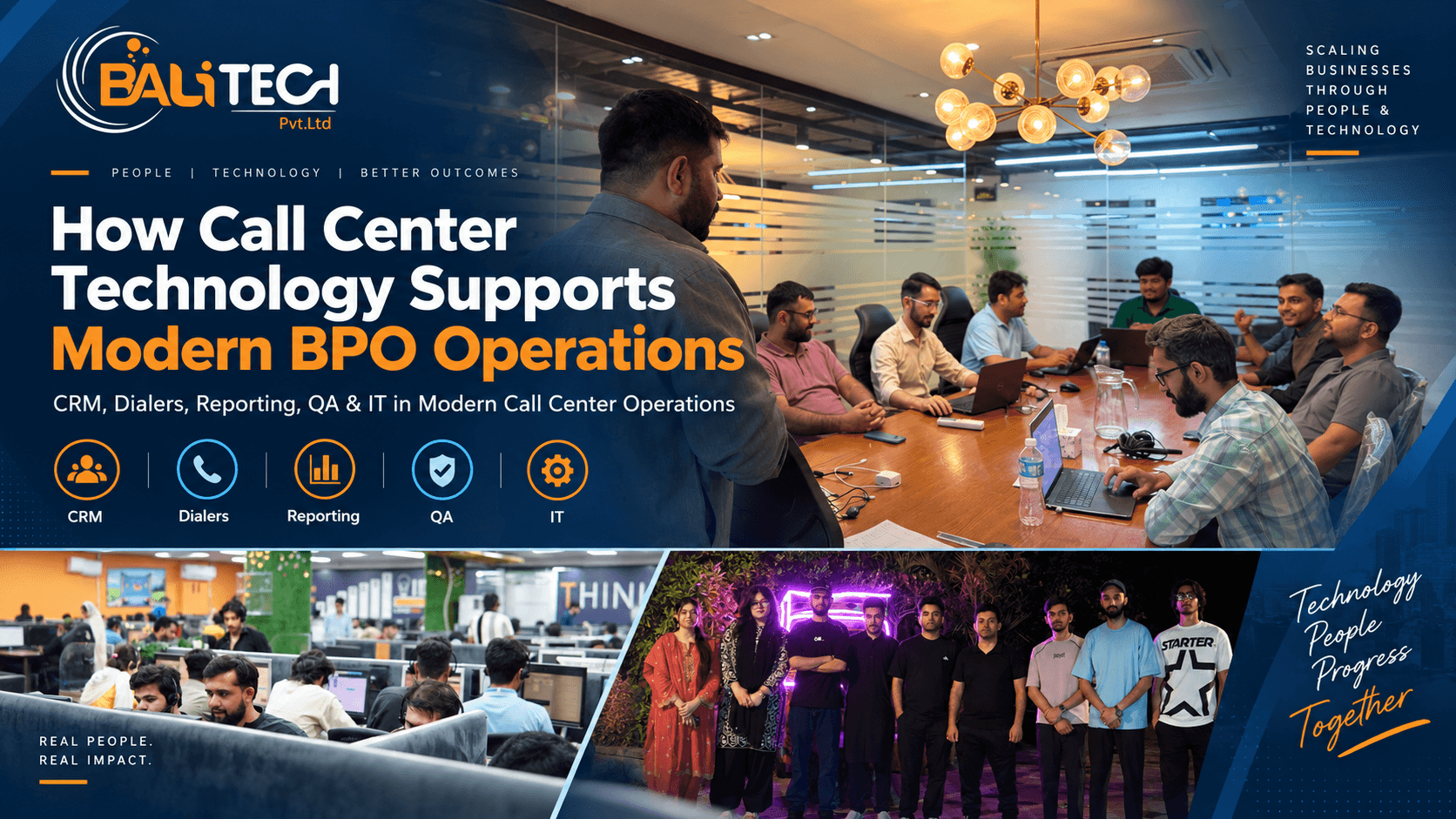
Modern BPO operations rely on more than agents and phone calls. See how CRM systems, dialers, telephony, reporting, QA and reliable technical infrastructure support the people running today's call center operations.
When a call center is working properly, most of the technology behind it is almost invisible. An agent opens the customer record, the next call connects, the right information appears on screen, a supervisor can see how the shift is progressing and the day's numbers eventually reach the people responsible for the campaign.
It becomes much easier to notice that technology when something stops working.
A dialer problem can slow an outbound team. Incomplete CRM information can make the next conversation harder than it needs to be. Poor call quality can affect a customer interaction that an agent was otherwise handling well. If reporting is unreliable, managers can finish a busy shift without a clear picture of what actually happened.
This is why call center technology has become part of everyday BPO operations rather than a separate technical subject sitting somewhere in the background.
For a modern BPO, the important question is not how many systems it can name. The real question is whether those systems help people handle work more consistently, give managers useful visibility and keep live campaigns running when the operation depends on them.
Technology Sits Behind Almost Every Call Center Interaction
A customer may only hear one agent during a call, but several systems can be involved in making that conversation possible.
The call has to reach the right place. The agent needs access to the information required for the conversation. The outcome may need to be recorded. A follow-up might be required. Quality teams may later review the interaction, while supervisors and managers need enough reporting to understand how the wider campaign is performing.
Inbound and outbound operations use technology differently, but both depend on it.
For an inbound team, the priority may be getting an incoming call to an available person, presenting the right customer information and making it easy to document what happened. An outbound campaign may depend more heavily on calling lists, dialer configuration, dispositions, callbacks and the relationship between the calling platform and the CRM.
That is why modern call center software is better understood as part of an operating process rather than simply as a tool installed on employee computers.
The people still run the operation. Technology gives those people a structured environment in which to work.
CRM Gives the Conversation Context
A caller rarely wants to explain everything from the beginning each time they speak with a business.
That is one reason CRM systems matter in call center operations.
A properly maintained CRM can give an agent context before or during the interaction. It may show previous activity, contact information, the current stage of a record or the next step expected in the process. In sales environments, the same system can help teams understand where a prospect sits in the journey and what happened during earlier contact.
The value of CRM in call centers, however, depends heavily on how people use it.
If outcomes are entered differently by different employees, managers eventually receive inconsistent information. If important fields are left empty, the next agent may have to repeat work that has already been done. If the workflow inside the CRM does not match the real campaign process, employees begin creating workarounds.
That is why CRM is as much an operational responsibility as a technical one.
The system needs a sensible workflow, but employees also need to understand what should be recorded and why it matters.
BaliTech's current service structure includes CRM configuration as part of campaign technology, while its inbound operating model also allows agents to be trained on client CRM and ticketing tools before handling live volume. Businesses interested in the wider operating setup can review the BaliTech BPO and call center services.
The Dialer Shapes the Rhythm of Outbound Work
Outbound calling creates a very different operational problem from waiting for incoming calls.
A team may have a large contact list, different campaign priorities, scheduled callbacks and outcomes that need to be recorded after every conversation. If agents are expected to manage all of that manually, a large part of their working day can be spent moving between records instead of speaking with people.
This is where the call center dialer becomes important.
The purpose of a dialer is not simply to make more calls. In a properly managed campaign, it helps organize calling activity around the process the business has defined.
Agents need to know which record they are working on. Call outcomes need to go somewhere useful. Follow-up actions need to remain visible. Managers need to understand what the calling activity is producing rather than looking only at how many numbers were attempted.
BaliTech's current outbound operation is described as dialer-driven, with CRM, dialer and telephony configured around individual campaigns. The company also supports different campaign requirements by agreeing targets and reporting against them. Readers interested specifically in this side of the operation can explore BaliTech's outbound call center services.
Telephony Is Easy to Ignore Until a Call Goes Wrong
The voice connection itself is one of the simplest parts of a call center to take for granted.
For the agent and the customer, a call is expected to connect and remain clear enough for both sides to understand each other. Behind that expectation sits the telephony layer that carries the interaction.
When the technology works, nobody needs to think much about it.
When it does not, the operational effect is immediate.
A poor connection can make an agent repeat information. A dropped call can interrupt a sale or customer-support conversation. Routing problems can send calls to the wrong place. Even a small technical problem becomes much larger when it affects a whole team instead of one employee.
For international campaigns, this becomes particularly important because teams may be working with customers in another market while operating from Pakistan.
That is why telephony should be discussed when a business evaluates a BPO provider or call center operation. It is not simply an IT detail. It is part of the customer experience and part of the employee's ability to do the job properly.
Reporting Turns a Busy Floor Into Something Managers Can Understand
A call center can look extremely active without necessarily producing the outcome the campaign needs.
Phones may be ringing. Agents may be speaking all evening. Supervisors may be moving across the floor solving problems. None of that, by itself, tells management whether performance is improving.
Reporting provides that second view of the operation.
The exact numbers that matter depend on the campaign. An inbound support team may need to understand call volume, handling, resolution and quality. An outbound team may care about contact outcomes, appointments, conversions or follow-up activity. Verification work may place more weight on process accuracy and quality scores.
The important part is agreeing what should be measured before relying on the report.
A dashboard filled with numbers is not automatically useful. Reporting becomes valuable when managers can connect those numbers with an operational question.
Why did contact rates change? Did quality improve after coaching? Is one part of the process creating repeated delays? Is volume increasing beyond the capacity of the current team?
Those are the questions that make call center reporting useful.
BaliTech currently describes daily volume reporting, performance dashboards and an agreed review cadence as part of the operating layer around its campaigns. That structure helps move performance discussions away from general impressions and toward information that both sides can review.
Quality Assurance Depends on Technology, but It Still Needs Human Judgment
Call monitoring is another area where technology and people meet.
A quality team needs access to the work it is expected to evaluate. That may involve reviewing recorded calls, looking at the information entered during the interaction and comparing the work with the agreed quality criteria.
The technology makes the review possible, but the value comes from what happens after the review.
A score by itself does not improve an employee.
Someone needs to understand why the issue happened, explain it clearly and help the agent correct it. If the same issue is appearing across several employees, management may need to look at training, scripting or the process itself rather than treating every example as an individual failure.
This is why call center QA should not be separated from the rest of operations.
BaliTech's current quality model includes sampled call reviews, scorecard-based feedback and escalation thresholds. In its inbound operation, calls can also be monitored and scored against criteria agreed with the client.
The system creates visibility. People still have to turn that visibility into improvement.
Good Technology Does Not Replace Good Training
A new employee can be given access to a CRM and still have no idea how the campaign actually works.
They may know where to click without understanding what information needs to be entered. They may know how to change a disposition without knowing what each outcome means. They may have a dialer in front of them without understanding how callbacks or escalations should be handled.
That is why training has to cover both the business process and the technology supporting it.
Employees need to understand how the systems fit into the conversation they are having.
For an inbound team, that could mean knowing where to find the right customer information and when to escalate an issue. For an outbound team, it may involve working correctly through a calling list, recording outcomes and following the campaign's next-step rules.
BaliTech's current inbound and outbound service models both describe campaign-specific training before agents begin handling live work. That connection between training and technology is important because a system only becomes useful when the people using it understand the process behind it.
Connectivity and Backup Systems Are Part of BPO Technology Too
CRM and dialers are visible to employees because they use them throughout the shift. Some of the most important technology in a BPO is much less visible.
Connectivity is one example.
A cloud system, CRM, dialer or telephony platform is only useful while employees can reach it reliably. If connectivity becomes unstable, several parts of the operation may be affected at once.
Power continuity matters for the same reason.
This becomes particularly important for physical BPO operations where large teams work from the same locations and live campaigns are scheduled around specific business hours.
BaliTech currently states that its campaign infrastructure includes redundant connectivity and backup power across its offices. The company operates physical locations across Rawalpindi and Islamabad, and current locations can be checked through the BaliTech offices page.
These infrastructure details may not sound as interesting as automation or CRM software, but they matter when the goal is keeping a real operation running.
IT in a BPO Is Closely Connected With Operations
IT inside a BPO has a practical responsibility: the systems people depend on have to remain usable.
An access problem can stop an employee from working. A computer issue can remove a seat from a live team. A network problem can affect communication. A telephony problem can interrupt calling. A poorly configured system can create unnecessary steps across an entire campaign.
This is why IT in BPO environments often sits closer to daily operations than people outside the industry might expect.
Technical teams need to understand that a small system problem can have a much larger operational effect when the same tool is being used by many people at once.
The reverse is also true. Operations teams benefit from understanding enough about their systems to explain the problem clearly rather than treating every technical issue as simply “the system is not working.”
That relationship between IT and operations is becoming more important as BPO environments depend on more software, connected platforms and reporting systems.
Where Software Development Fits Into BPO Operations
Development is not the core service of every BPO, and it should not be presented that way.
But software development skills can become useful as an organization grows and its internal processes become more complicated.
Sometimes the problem is repetitive manual work. Sometimes information has to move between systems. A manager may need a clearer internal dashboard. A department may have a workflow that no longer makes sense when hundreds of people are using it. Existing tools may need to exchange information more cleanly.
Those are the kinds of operational problems where development can become relevant.
The objective should not be to build software simply because software can be built. The useful question is whether a technical change removes unnecessary work, improves visibility or makes an existing process easier to manage.
This is also one reason developer jobs, software jobs and technology careers can exist outside traditional software companies. Modern organizations increasingly need people who understand both systems and the real business processes those systems support.
This article does not imply that a specific developer position is currently available at BaliTech. Anyone researching IT jobs in Rawalpindi, IT jobs in Islamabad, developer jobs or other technical opportunities should use the current BaliTech Careers page to see what is actually open at the time of application.
Automation Works Best When the Process Is Already Clear
Automation is attractive because repetitive work is frustrating.
But automating a confusing process usually creates a faster confusing process.
Before automation is introduced, the team needs to understand what should happen, when it should happen and what information is required.
Once that is clear, call center automation can help with repetitive parts of the workflow. Information may be passed between systems automatically. Reports can be generated without rebuilding the same file every day. Alerts can bring attention to unusual conditions. Follow-up actions can become easier to track.
That can save time, but human judgment still matters.
A difficult customer conversation cannot always be reduced to a workflow. Coaching needs context. Managers still need to understand why performance changed. Quality teams still need to decide whether an interaction met the standard expected from the campaign.
The best use of automation is often not replacing people. It is removing unnecessary repetitive work around them.
People, Process and Technology Have to Agree With Each Other
A CRM cannot fix an unclear sales process.
A dialer cannot make poor contact data useful.
A dashboard cannot tell management what success means if nobody has agreed what the campaign should achieve.
This is where some technology discussions become unrealistic. The software is treated as though it will solve an operational problem by itself.
In practice, the three parts need to work together.
People need training and clear responsibilities. The process needs to explain how the work should move from one stage to another. Technology should make that process easier to follow, record and measure.
When one part is missing, the other two usually become harder to manage.
This relationship is particularly important for BPO operations because the same process may be used by an entire team rather than one individual. A small weakness can therefore repeat dozens or hundreds of times during normal operations.
Inbound and Outbound Teams Need Different Technology Priorities
It is easy to speak about “call center technology” as though every campaign uses the same setup.
They do not.
An inbound team begins with incoming demand. Routing, availability, customer context, escalation and service visibility may be central to the operation. Employees need to receive the interaction and understand enough about the customer or process to handle it properly.
An outbound team begins from the opposite direction. The campaign is initiating contact, so calling lists, dialer setup, dispositions, contact outcomes, callbacks and performance reporting become especially important.
The difference affects the way technology should be configured.
A business therefore should not choose a call center platform or BPO technology stack simply because it contains a long list of features. The systems have to fit the type of work the team is actually expected to perform.
Readers interested in the inbound side can review BaliTech's inbound call center operating model, while its outbound service page provides more detail on dialer-driven calling and campaign setup.
Technology Gives Supervisors a Better View of the Floor
Supervisors cannot manage a large team by standing behind every employee.
They need enough information to know where attention is required.
Reporting can reveal changes in activity. Quality scores can highlight coaching needs. Campaign outcomes can show whether performance has moved after a process or script change. Call monitoring can give supervisors context that numbers alone cannot provide.
The aim is not to watch employees for the sake of watching them.
Useful operational visibility helps a supervisor identify a problem early enough to do something about it.
If several people are struggling with the same stage of a campaign, the issue might be training. If one workflow is producing inconsistent outcomes, the process might need to be reviewed. If activity changes suddenly, management can investigate rather than waiting until the end of the week to notice.
This is where call center reporting technology becomes useful to people who are responsible for real teams rather than just producing reports for presentation.
Technology Also Matters When a BPO Needs to Scale
A process that works for ten people does not always work the same way for one hundred.
As a team grows, inconsistencies become more visible.
Different employees may start recording information differently. Managers may lose visibility if reporting was designed for a smaller group. Manual processes that were manageable at low volume can become slow. Access and permissions need more structure.
Technology can help a BPO scale, but only when the underlying process has been designed with growth in mind.
This is why systems, reporting and management structure should be considered before a campaign becomes difficult to control.
BaliTech's wider service model is built around dedicated team management, QA and agreed reporting, with campaign structure defined before live operations begin. Readers researching how those elements fit together can explore the company's outsourcing services and delivery model.
Call Center Technology in Rawalpindi and Islamabad
Rawalpindi and Islamabad have an active BPO and call center employment market, and the two cities are closely connected for both operations and professional careers.
For businesses researching a call center in Rawalpindi or a BPO in Islamabad, technology should be part of the evaluation rather than an afterthought.
The same is true for someone searching for the best call center in Rawalpindi. “Best” should not be judged only by the size of an office, the number of people visible on a floor or a marketing claim. The systems supporting agents, the quality process, reporting, management, training and business continuity all affect how reliably an operation can perform.
BaliTech currently operates across Rawalpindi and Islamabad, with physical offices supporting its BPO operations. Its public service structure includes CRM and dialer setup, telephony, QA, reporting, redundant connectivity and backup power as parts of the operating layer around campaigns.
That local operating presence also explains why technology, call center careers and BPO jobs increasingly intersect. A modern call center needs more than agents; it needs people who can support the systems and processes those agents depend on.
What Businesses Should Ask About Technology Before Outsourcing
A company considering outsourcing does not need to become an expert in call center software before speaking with a BPO provider.
It does need to ask practical questions.
Which system will agents use? Can they work inside the client's existing CRM? How will calls be handled? What happens when connectivity fails? Which information will appear in reports? How often will those reports be reviewed? How are calls evaluated for quality? Who is responsible when a technical issue begins affecting live work?
The answers should connect back to the actual campaign.
An inbound support operation may need a different technology setup from an outbound sales team. A regulated verification campaign may require different controls from general customer support. A small pilot may not need the same structure as a mature team handling large daily volume.
The right technology is therefore the technology that fits the process being outsourced.
More Software Does Not Automatically Mean a Better Call Center
There is a temptation to measure technology maturity by counting tools.
A CRM, dialer, dashboard, monitoring platform, automation system and several integrations can sound impressive. They can also create unnecessary complexity if the team has to move between systems that do not fit together.
A simpler setup that employees understand can be more effective than a larger stack nobody uses consistently.
This is particularly important in call center environments because employees work quickly. A process that adds several unnecessary steps to every call can become significant when repeated across a whole campaign.
Good call center technology should make the work clearer.
Agents should understand what they need to do. Supervisors should be able to see what matters. Managers should receive information they can use. Technical staff should be able to identify and resolve problems without making the operating process unnecessarily complicated.
Technology Careers Are Becoming Part of the BPO Story
The BPO industry is often associated with agents, sales staff and customer service representatives because those are the most visible roles.
Technology-supported operations create a wider professional environment.
IT support, systems administration, reporting, dialer operations, CRM management and development skills can all become relevant as an organization grows and depends more heavily on connected systems.
This does not make every BPO a technology company.
It means technology is becoming more closely tied to the work BPO teams already perform.
For professionals researching IT jobs in Rawalpindi, IT jobs in Islamabad, technology jobs, software roles or developer jobs, BPO organizations can therefore be part of the wider employment market alongside more traditional technology businesses.
Because vacancies change, anyone interested specifically in working at BaliTech should check the current career opportunities instead of assuming a particular technical position is available.
How Technology Fits Into BaliTech's BPO Model
BaliTech's public operating model places technology alongside management, quality assurance and reporting rather than treating it as a separate service unrelated to campaign delivery.
The company's Services page currently describes dialer, CRM and telephony setup around campaign requirements, together with redundant connectivity and backup power. Reporting includes agreed metrics, daily volume visibility and performance dashboards, while QA is based around call review and scorecard feedback.
That structure reflects an important point about modern BPO operations.
The technology exists to support the campaign.
The agent still has to communicate effectively. The supervisor still has to manage the team. Quality teams still have to understand what good performance looks like. Managers still have to decide what the numbers mean.
Systems make those responsibilities easier to coordinate and measure, but they do not remove them.
Businesses that want to understand how BaliTech structures outsourced teams can review the complete BPO and call center services. Those researching the organization itself can also learn more about BaliTech and its wider operating structure.
Modern BPO Technology Is Really About Making Operations Work Better
The most useful call center technology is rarely the system with the longest feature list.
It is the technology that solves a real operational problem.
A CRM should make customer or prospect information easier to use. A dialer should organize outbound activity around the campaign. Telephony should allow people to communicate reliably. Reporting should give management a clearer view of performance. Quality systems should support review and coaching. Infrastructure should keep those tools available when the team needs them.
Once those fundamentals are in place, automation and development can improve the parts of the workflow that still create unnecessary manual work.
That is the practical relationship between people and technology inside a modern BPO.
The technology should not become the operation.
It should help the operation work better.
Frequently Asked Questions About Call Center Technology
What technology is used in a modern call center?
Modern call center operations can use CRM systems, dialers, telephony platforms, reporting tools, call monitoring, quality systems and internal workflow applications. The exact setup depends on whether the operation handles inbound calls, outbound campaigns, customer support, sales or another business process.
Why is CRM important in call center operations?
CRM helps employees work with customer or prospect information in a consistent place. It can support history, workflow, dispositions, follow-up and reporting, but its value depends on how well the process is configured and how consistently employees use it.
What does a call center dialer do?
A call center dialer helps organize outbound calling activity. Depending on the campaign setup, it can reduce manual dialing, help teams work through contact lists and support consistent recording of call outcomes and callbacks.
How does technology help call center quality assurance?
Technology can provide access to recorded interactions, operational records and performance information that quality teams need for review. Human QA staff still need to evaluate the work against agreed standards and turn their findings into useful coaching or process improvements.
Why is call center reporting important?
Reporting helps managers understand what is happening beyond the visible activity on the floor. Useful reports connect campaign metrics with operational questions so teams can identify changes in volume, quality, outcomes or productivity and investigate them properly.
What is the role of IT in BPO operations?
IT helps maintain the technical environment employees depend on, including computers, connectivity, user access, calling systems and business applications. In a BPO environment, technical issues can quickly become operational issues when the same systems support an entire team.
Does automation replace call center agents?
Automation can reduce repetitive administrative work and improve workflows, but many customer conversations, quality decisions, coaching situations and operational problems still require human understanding and judgment. The strongest use of automation is usually supporting people rather than assuming every interaction should be removed from them.
Do BPO companies employ developers and technology professionals?
Some BPO organizations need technical professionals for IT support, reporting, system administration, CRM work, integrations, workflow improvement or internal development. The exact roles vary between organizations and should not be assumed to be open at any particular time.
What should businesses consider when looking for the best call center in Rawalpindi?
Businesses should look beyond the word “best” and examine how the team is trained and managed, what technology supports the operation, how quality is monitored, what reporting is provided and how the provider handles business continuity and campaign-specific requirements.
Does BaliTech use CRM and dialer technology in its BPO operations?
BaliTech's current public service information describes dialer, CRM and telephony configuration as part of campaign delivery, together with quality assurance, reporting, redundant connectivity and backup power. The exact setup depends on the requirements agreed for the campaign.
Where does BaliTech operate?
BaliTech currently operates physical offices across Rawalpindi and Islamabad. Current office details can be checked on the official BaliTech offices page.