October 2, 2026
Inside a Modern BPO People, Technology and Operations Behind the Work
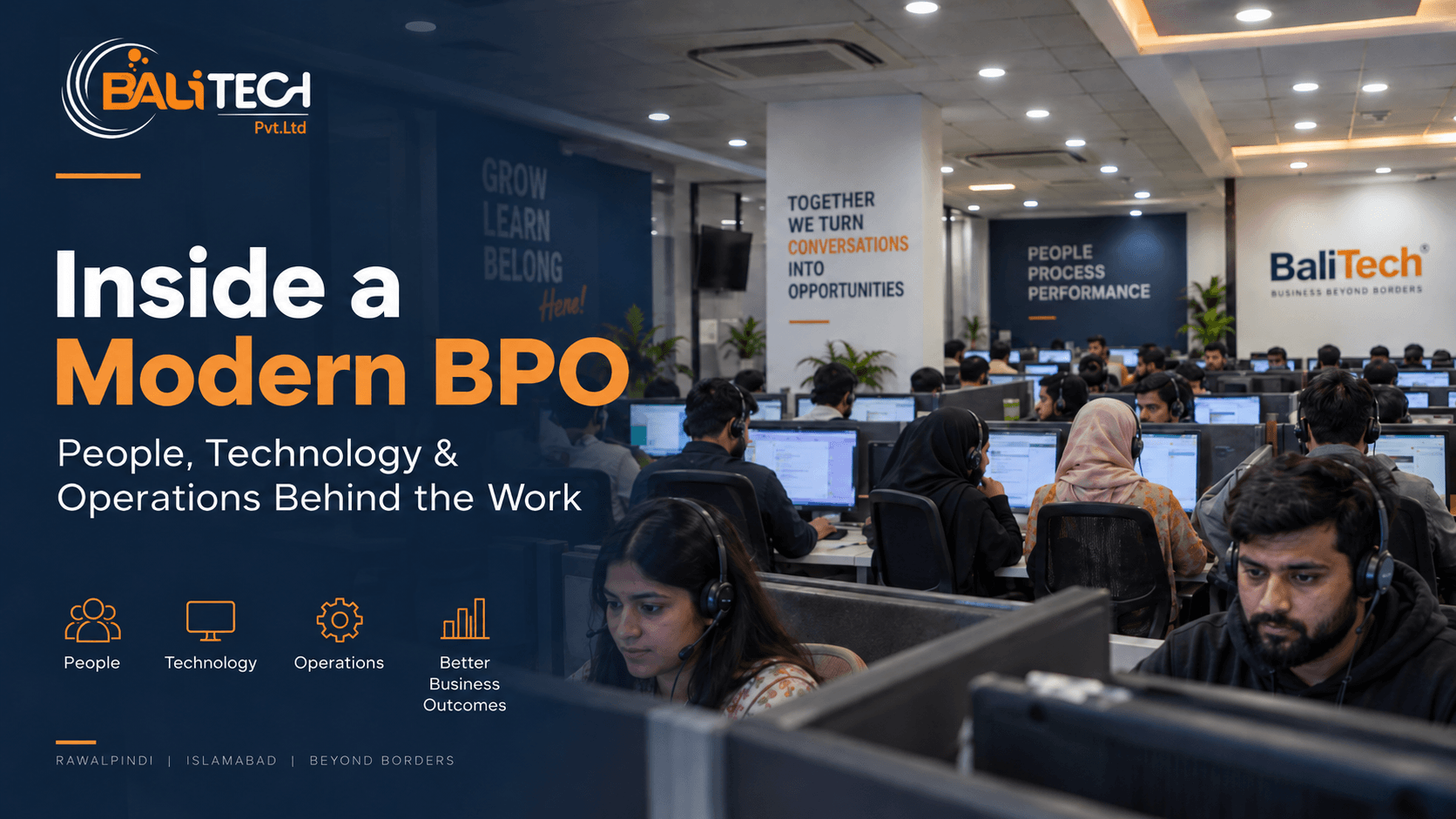
A modern BPO is built around far more than phone calls. Inside the operation are trained teams, supervisors, quality assurance, reporting, CRM systems, dialers, telephony, technology support and structured processes working together. This article looks behind the scenes at how people, technology and operations connect inside a modern BPO.
A modern BPO can look straightforward from the outside. There are people speaking with customers, handling sales calls, answering enquiries or working through a business process. Behind those conversations, however, is a much larger operation.
Agents need systems to work from. Team leaders need visibility into performance. Quality teams need calls and processes they can review. Trainers need to prepare people before they start handling live work. Managers need reporting they can trust. Dialers, CRM systems, telephony, connectivity and internal technology have to keep working while all of this is happening.
That is the part of business process outsourcing that customers and job seekers do not always see.
For companies researching a BPO in Pakistan, a call center in Rawalpindi or a BPO company in Islamabad, understanding this operating layer is more useful than looking at the number of seats on a floor. The people answering calls are important, but the processes, management and technology surrounding those people determine how the operation actually works.
BaliTech operates across Rawalpindi and Islamabad with multiple BPO delivery functions, including inbound and outbound calling, customer support, lead generation, B2B outreach, sales and verification, and business process support. Its current operating model also includes supervision, quality assurance, reporting and technology such as CRM, dialer and telephony systems.
This is what a modern BPO looks like when the operation is viewed as a whole.
A BPO Is More Than a Room Full of Call Center Agents
The words “BPO” and “call center” are often used as though they mean exactly the same thing. They overlap, but they describe different things.
A call center is generally focused on voice-based customer or prospect interactions. Those conversations may involve customer service, inbound enquiries, outbound sales, lead generation, follow-up, verification or appointment setting.
Business process outsourcing is broader. Calling may be an important part of the operation, but the outsourced work can also involve customer support processes, research, documentation, reporting, verification, billing support, records work and other repeatable business activities.
That distinction matters for a company evaluating BPO services in Pakistan. A business may initially think it needs several agents to answer phones, but the real requirement could involve an entire managed workflow: recruitment, training, supervision, quality control, technology, reporting and process ownership.
The same distinction matters when people search phrases such as best call center in Rawalpindi, best call center in Islamabad or even best call center in Pakistan. The word “best” means very little without understanding what sits behind the operation. A business running customer support has different requirements from one running outbound acquisition, verification or B2B outreach.
The useful question is not simply which company has a call center. It is whether the operating structure matches the work that needs to be done.
The People Behind a Modern BPO Operation
Technology gets more attention every year, but BPO is still a people-intensive business.
The frontline team is the most visible part. In an inbound operation, agents may answer customer enquiries, follow defined processes and route issues that require escalation. An outbound team may work on sales, acquisition, appointment setting, follow-up or retention. Lead generation teams may research prospects, qualify opportunities and move suitable leads toward a handover.
Those employees are only one part of the operation.
Team leaders and supervisors sit closer to day-to-day performance. They need to understand attendance, activity, quality and campaign requirements while helping employees deal with problems that appear during live work.
Quality assurance teams look at the work from another angle. Their job is not simply to listen for mistakes. They need a defined standard against which calls and processes can be evaluated. Useful QA creates a feedback loop: review the work, identify a problem, coach the employee and check whether performance improves.
Training connects directly with that process. A person cannot be expected to handle a live campaign properly if they do not understand the product, scripts, systems, escalation path and quality expectations. In a structured BPO operation, training begins before live work and continues when the campaign changes.
Operations managers then have to connect all of those pieces. They are looking beyond one conversation or one employee. They need to understand team performance, staffing, quality, productivity, client requirements, reporting and operational risks.
That is why a modern BPO is less about individual job titles and more about how those roles work together.
How Call Center Operations Actually Work
A professional call center operation starts before the first live call.
The campaign needs a defined objective. The team needs to understand what type of calls it will handle. Scripts or conversation guidelines have to be agreed. Escalation rules need to be clear. The CRM or business system must be prepared. Reporting requirements need to be defined. Quality standards must be understood.
Inbound and outbound operations then take different paths.
Inbound call center services are built around incoming demand. The customer starts the interaction, so the team needs to be ready when the call arrives. That creates questions around coverage, response times, process knowledge, escalation and resolution.
Outbound call center services work differently. The team initiates contact, which makes calling volume, contact strategy, dialer configuration, data quality, scripts and follow-up processes especially important.
Lead generation adds another layer. The goal is not simply to make a high number of calls. The operation needs agreed qualification criteria so the sales team receiving the lead understands why it was passed forward.
B2B outreach can be more targeted again. Instead of contacting a broad consumer audience, the team may work from defined account lists, identify the appropriate decision-makers and manage a structured outreach sequence.
Verification work has its own demands because accuracy and process adherence can matter as much as conversational ability.
These are all call center functions, but they are not interchangeable. A company researching call center services in Rawalpindi or call center services in Islamabad should understand exactly which operating model it needs before comparing providers.
BaliTech explains its current inbound, outbound, support, lead generation, verification, B2B and business-process capabilities on its BPO and call center services page.
The Technology Behind the Operation
People may run the campaign, but technology gives those people the environment in which to work.
This is where the idea of BPO technology becomes practical rather than abstract.
A modern operation may need a CRM to maintain customer or prospect information. An outbound campaign may use a call center dialer to manage calling activity. Telephony connects the conversation. Reporting systems turn activity into information managers can review. Quality teams need access to the interactions or records they are responsible for evaluating.
None of these systems is valuable simply because it exists.
A CRM becomes useful when employees record information correctly and the workflow reflects the process the campaign is supposed to follow. A dialer becomes useful when it is configured around the needs of the operation rather than simply trying to produce the largest possible number of calls. Reporting becomes useful when the numbers help managers understand what is working and where attention is needed.
This is why call center technology should be viewed as part of operations rather than a separate layer installed by an IT department and forgotten.
At BaliTech, the current service structure publicly describes dialer, CRM and telephony configuration as part of the operating environment, alongside reporting, quality assurance and campaign management. The technology exists to support the people running the process.
CRM in Call Centers Is About More Than Customer Records
CRM is one of the most frequently used terms in sales and customer operations, but it can mean different things depending on the campaign.
At its simplest, a CRM gives the team one place to work with customer or prospect information. In practice, its role can extend much further.
An agent may use the CRM to understand where a record came from, what happened during a previous interaction and what should happen next. A verifier may need to confirm that required information has been captured. A supervisor may need visibility into activity or outcomes. A manager may depend on CRM data when reviewing campaign performance.
That makes CRM in call centers both a technology issue and an operational issue.
If employees do not follow the workflow properly, the software cannot solve the problem by itself. If fields are incomplete or outcomes are recorded inconsistently, reporting becomes less useful. If the process inside the CRM does not match what the campaign requires, employees spend more time working around the system.
Good CRM use therefore depends on three things working together: the system, the process and the people using it.
This is also why CRM knowledge can become valuable outside traditional technical roles. Sales agents, customer support staff, verifiers, supervisors, QA teams and operations staff may all interact with CRM information in different ways.
Why Dialers and Telephony Matter in Outbound Operations
In an outbound environment, the dialer is one of the systems closest to daily productivity.
A call center dialer helps organize calling activity, but its role is broader than simply placing calls. The way campaigns, queues, records and calling rules are structured can affect how agents work throughout the day.
Telephony has to work alongside that environment. When voice quality, routing or connectivity fails, productivity is affected immediately because the core interaction cannot take place properly.
This makes technical reliability an operational issue.
A manager may not personally configure every piece of call center software, but they still depend on it. Agents may not maintain the infrastructure, but their performance can be affected when that infrastructure is unreliable.
For businesses considering an outbound call center in Rawalpindi or an international call center in Islamabad, technology should therefore be part of the outsourcing discussion from the beginning.
Reporting Turns Activity Into Something Managers Can Use
A busy call center can look productive without actually producing the intended result.
That is why modern BPO operations need reporting.
Different campaigns care about different numbers. An inbound operation may focus on service and handling measures. An outbound campaign may care about contact, conversion or appointment outcomes. Lead generation may require visibility into qualification and handover. Verification work may be judged partly through process accuracy and quality.
Reporting gives the client and operations team a common picture of what is happening.
The important part is not producing as many charts as possible. It is agreeing which numbers matter before the campaign begins and reviewing those numbers consistently.
When reporting works properly, performance conversations become more specific. Instead of saying a campaign “feels slow,” managers can look at activity and determine where the change occurred.
This is one reason call center reporting and performance dashboards are now closely connected with serious BPO operations.
Quality Assurance Is Part of the Operating System
Quality assurance is sometimes treated as a department that listens to calls after the real work has already happened.
That misses its real value.
QA should connect directly with the way an operation improves.
A clear scorecard gives the team a consistent standard. Call or process reviews identify gaps. Coaching gives employees the chance to understand the issue. Later reviews show whether the problem has been corrected.
Quality assurance also helps managers see whether an issue belongs to one person or is appearing across the team. If several employees struggle with the same part of a process, the answer may be better training or a clearer workflow rather than simply more individual criticism.
BaliTech currently describes call monitoring, scorecard-based feedback, escalation thresholds and regular performance review as parts of its operating structure.
That is why call center QA belongs inside a discussion about operations rather than being treated as an isolated department.
Training Connects People With the Process
Hiring people is only the beginning of building a BPO team.
A new employee still needs to understand the campaign.
That may include learning the product or service, understanding the purpose of the call, becoming familiar with scripts, learning the CRM workflow, understanding escalation rules and knowing what quality assurance will evaluate.
The training requirement can also change as the campaign develops.
A script may be updated. The client may change a process. QA may identify a repeated weakness. A new system step may be introduced. The operation needs a way to move that information back to the employees responsible for live work.
This is why campaign-specific training and coaching are operational requirements, not simply employee benefits.
They help close the gap between what the process says should happen and what is actually happening on the floor.
Where IT Fits Into a Modern BPO
Once a BPO becomes dependent on CRM platforms, dialers, telephony, connectivity, user accounts, computers, reporting tools and internal systems, technical work becomes part of daily operations.
That creates an important role for IT.
IT in BPO is not necessarily the same as IT inside a software product company. The priority is often keeping a live business environment stable.
Hundreds of employees can depend on systems being available at the same time. An account-access issue, network problem, telephony fault or system outage may affect more than one person. It can interrupt a team or campaign.
Technical teams therefore need to understand the operational effect of the systems they maintain.
This is where searches such as IT jobs Rawalpindi, IT jobs Islamabad, BPO technology jobs and technical support BPO begin to connect with the wider outsourcing industry.
That does not mean every BPO is currently hiring for every technical role. It means modern operations need technical capability behind the business.
Where Developers Fit Into Business Operations
Developers are not usually the first people someone imagines when thinking about a call center.
As operations become more technology-dependent, however, development skills can become relevant.
A business may need internal workflows improved. Data may need to move between systems. A reporting process may need automation. An operational dashboard may need to present information in a clearer way. Internal tools may need to support departments that were previously managing work manually.
This is where software development can meet BPO operations.
People searching for developer jobs in Rawalpindi, developer jobs in Islamabad, software jobs Rawalpindi or technology careers in Pakistan may therefore find technical opportunities in industries beyond traditional software companies.
It is important to keep this distinction accurate. BaliTech is primarily a BPO organization. This article is not claiming that every development role is currently available at BaliTech. Current vacancies should always be checked separately through the official BaliTech Careers page.
Automation Helps When It Removes Repetitive Work
Automation is another word that can become vague very quickly.
In a BPO operation, useful automation usually begins with a repetitive problem.
Perhaps information is being copied between systems unnecessarily. Perhaps managers are building the same report manually every day. Perhaps an operational alert can be generated automatically instead of waiting for someone to notice the issue.
The purpose of call center automation should be to make the process clearer or more efficient while preserving the controls the operation still needs.
Automation does not remove the need for people in every situation. Customer conversations, coaching, judgement, escalation and management still depend heavily on human understanding.
The better question is where technology can remove unnecessary repetitive work so people can spend more time on the parts of the process that require attention and judgement.
People and Technology Depend on Process
A powerful CRM cannot repair an unclear business process.
A modern dialer cannot compensate for poor campaign data.
A strong agent cannot consistently deliver the right result if nobody has explained what the right result looks like.
This is why process sits between people and technology.
Before a BPO team can run effectively, someone needs to define how work enters the operation, who handles it, what information is required, how an exception is escalated and how the final outcome is recorded.
Once that process is clear, technology can support it and people can be trained around it.
This may sound simple, but it is one of the clearest differences between an informal calling setup and a structured BPO operation.
How a BPO Team Moves From Planning to Live Operations
A managed BPO operation usually starts with understanding the work rather than immediately adding agents.
The business requirement has to be mapped first. That includes the target audience, expected volumes, process, performance measures, systems and any compliance requirements relevant to the campaign.
From there, the team structure can be decided.
Agents need to be recruited or assigned. Training has to cover the campaign and systems. Reporting needs to be prepared. QA needs to understand what will be measured.
The team can then move into live activity under supervision.
The work does not stop at launch. Real campaigns generate information that planning cannot always predict. Managers begin to see where customers respond differently, where agents need more coaching, where scripts need clarification and whether staffing matches the actual workload.
A mature operation uses that information to improve.
BaliTech describes this cycle through discovery, team building, training, launch, QA, reporting and ongoing optimization as part of its wider outsourcing operating model.
Why Rawalpindi and Islamabad Matter to the BPO Industry
Rawalpindi and Islamabad have become closely connected employment and operating markets for businesses in the BPO and call center sector.
That is reflected in the way people search.
Some businesses look for a BPO company Rawalpindi. Others search for BPO services Islamabad, a call center in Rawalpindi, an international call center in Islamabad or simply a BPO in Pakistan.
Job seekers approach the same market from another direction through searches such as BPO jobs Rawalpindi, call center jobs Islamabad, IT jobs Rawalpindi or technology jobs Islamabad.
The two cities therefore matter both as a service market and as a professional employment market.
BaliTech currently operates four physical offices across Rawalpindi and Islamabad. Readers who want to understand where those operations are located can view the current BaliTech office locations.
What “Best Call Center” Should Mean to a Business Buyer
Searches such as best call center in Rawalpindi, best call center in Islamabad, best call center in Rawalpindi and Islamabad and best call center in Pakistan are understandable. Businesses want confidence before handing customer conversations or important processes to another company.
But “best” is not a useful operating specification.
A company evaluating a call center or BPO should ask more specific questions.
How is the team managed? How are agents trained? What happens when quality drops? What reporting will the client receive? Which CRM or business system will the team use? How is telephony handled? What happens if volume grows? How are problems escalated? Does the operation understand the type of campaign being outsourced?
Those questions give a business something concrete to compare.
The best outsourcing fit is therefore not automatically the organization with the loudest claim. It is the operation whose people, technology, management and processes fit the work being handed over.
International Campaigns Add Another Operational Layer
International BPO work brings its own practical requirements.
Teams may need to work according to the business hours of another market. Communication standards can differ. Clients may expect specific reporting. Scripts and processes may need to reflect the campaign being run.
This is particularly relevant for an international call center in Rawalpindi, an international call center in Islamabad or companies providing international BPO services from Pakistan.
BaliTech currently describes its operations as supporting international campaigns with 24/5 operating coverage.
Again, the importance is not simply that the campaign is international. What matters is whether the team, systems and management structure have been organized around the campaign's actual requirements.
Job Opportunities Inside a Modern BPO Are Broader Than Calling
The same operating structure that serves clients also creates different professional career paths.
Frontline calling remains an important entry point. Inbound agents, outbound agents, customer support employees, lead-generation teams and verifiers all work close to the customer or prospect.
Behind them are roles connected with quality assurance, training, team leadership, operations, recruitment, HR and technology.
As systems become more important, technical skills also become relevant. CRM support, dialer operations, IT support, reporting, systems administration and development can all connect with the wider BPO environment depending on the structure of the organization.
This does not mean every position is open at every time.
Someone searching for job opportunities in Rawalpindi, BPO jobs Islamabad, call center careers, CRM jobs, developer jobs Rawalpindi or IT jobs in BPO should always check the employer's current vacancies rather than treating general career information as a job advertisement.
For current opportunities at BaliTech, the correct source is the official BaliTech job openings and Careers page.
What Makes a BPO Operation Modern?
A modern BPO is not defined by having the newest-looking office or the largest software stack.
It is defined by how effectively people, process and technology work together.
The people need to understand the work. The process needs to be clear enough to follow and measure. The technology needs to support that process without making the work unnecessarily complicated. Managers need enough visibility to know when performance changes. QA and training need a way to turn mistakes into improvement.
When those pieces are disconnected, the operation becomes harder to control.
When they work together, the organization can handle more complicated business processes than the traditional image of a call center suggests.
This is also why the BPO industry is increasingly relevant to people interested in technology, CRM systems, IT, reporting and software development. Those functions are becoming part of the infrastructure that modern customer and business operations depend on.
Inside BaliTech's People, Technology and Operations Model
BaliTech's current public service structure reflects this broader model.
The company operates inbound and outbound call functions as well as customer support, lead generation, B2B outreach, sales and verification, medical billing support and other business-process work.
Around those teams is an operating layer that includes supervisors, quality assurance, reporting and campaign-specific technology. Its service information describes CRM, dialer and telephony configuration, performance visibility and structured onboarding as parts of campaign delivery.
That matters because BPO performance is rarely created by one department.
An agent may have the conversation, but training prepared the agent. The dialer or telephony system connected the call. The CRM provides the workflow. QA reviews the interaction. A supervisor manages the team. Reporting tells the client and operations team what happened.
Those connections are what turn individual activities into an operation.
Businesses considering outsourcing can explore BaliTech's current BPO and call center services, while readers wanting company background can learn more about BaliTech's development and operating structure.
The Future of BPO Will Still Depend on Getting the Basics Right
The technology around BPO will continue to change.
CRM platforms will become more capable. Reporting will become faster. Automation will remove more repetitive tasks. Internal tools will connect information that used to sit in separate places.
Those changes matter, but they do not remove the fundamentals.
Customers still need to be understood. Sales conversations still need to be handled properly. Processes still need clear ownership. Employees still need training. Managers still need reliable information. Technical systems still need to stay available.
The companies that use technology well will not necessarily be the ones using the most tools. They will be the ones that understand where technology genuinely improves the operation.
That is the practical relationship between BPO, call centers, CRM, IT, development and automation.
They are not separate trends competing for attention. They are increasingly connected parts of the same operating environment.
Understanding the Modern BPO From the Inside
Seen from outside, a call center can appear to be a collection of people making and receiving calls.
Seen from inside, the picture is much more detailed.
There are agents handling live conversations, supervisors managing performance, QA teams reviewing quality, trainers developing people, operations teams coordinating campaigns and technical systems keeping information and communication moving.
CRM, dialers, telephony, reporting and internal technology give those teams the infrastructure they need. IT keeps that environment usable. Development and automation can improve workflows as operations become more complex.
That is what makes modern business process outsourcing different from the narrow image many people still have of a call center.
For a business looking for a BPO company in Pakistan, a BPO in Rawalpindi or BPO services in Islamabad, understanding these layers makes it easier to evaluate what is actually being offered.
For professionals exploring BPO job opportunities, IT roles, CRM work or technology careers, it also shows how many different skills can exist behind a live operation.
And for BaliTech, the connection between people, technology and operations is the clearest way to explain what happens beyond the call itself.
If your business is evaluating customer support, outbound calling, lead generation, verification or another outsourced process, explore BaliTech's outsourcing services to understand how the current delivery model is structured.
Frequently Asked Questions About Modern BPO Operations
What is a modern BPO?
A modern BPO manages defined business processes using trained teams, supervision, technology, reporting and quality controls. The work can include call center services, customer support, lead generation, verification, outreach and back-office processes depending on the provider and client requirement.
What is the difference between a BPO and a call center?
A call center primarily focuses on voice interactions such as inbound support or outbound calling. BPO is a broader model that can include call center work along with other repeatable customer, sales, administrative or back-office business processes.
What technology is used in modern call centers?
Technology varies by campaign, but modern call center operations can involve CRM platforms, dialers, telephony, reporting tools, quality monitoring systems, internal workflow applications and connectivity infrastructure.
Why is CRM important in a call center?
A CRM helps teams maintain customer or prospect information, follow workflows, document outcomes and support reporting. Its value depends on how well the system is configured and how consistently employees use the process built around it.
What does a call center dialer do?
A dialer supports outbound calling activity by helping organize and distribute calls according to the campaign setup. Dialer configuration should fit the calling process, reporting requirements and operational controls of the campaign.
What does quality assurance do in a BPO?
Quality assurance reviews calls or processes against defined standards. The findings can then be used for coaching, process improvement and identifying repeated issues across an individual employee or wider team.
Are there IT jobs in BPO companies?
BPO operations increasingly depend on computers, networks, CRM systems, dialers, telephony and internal applications, which creates a need for technical skills in the industry. Specific vacancies depend on each organization and should always be checked through the employer's current careers page.
Do developers work in BPO companies?
Development skills can be useful where a BPO maintains internal systems, automates workflows, builds reporting tools or connects operational applications. That does not mean every BPO employs developers or has developer vacancies at all times.
What should a business look for when searching for the best call center in Rawalpindi or Islamabad?
Instead of relying only on the word “best,” businesses should evaluate the team structure, training, quality assurance, management, reporting, technology, communication, scalability and experience relevant to the specific process they want to outsource.
Does BaliTech operate in Rawalpindi and Islamabad?
Yes. BaliTech currently operates physical offices across Rawalpindi and Islamabad. Current addresses and office information are available on the official BaliTech offices page.
What BPO services does BaliTech provide?
BaliTech currently presents inbound and outbound calling, customer support, lead generation, B2B outreach, sales and verification, medical billing support and broader business-process support within its service structure. Businesses can review the latest information on the BaliTech Services page.
How can I find current job opportunities at BaliTech?
Current vacancies should be checked through the official BaliTech Careers page. Available roles can change as campaigns and departments change, so the live careers section should be treated as the current source rather than older job posts.