October 6, 2026
Behind BaliTech’s Sales Pipeline How Lead Generation, Outreach and People Work Together
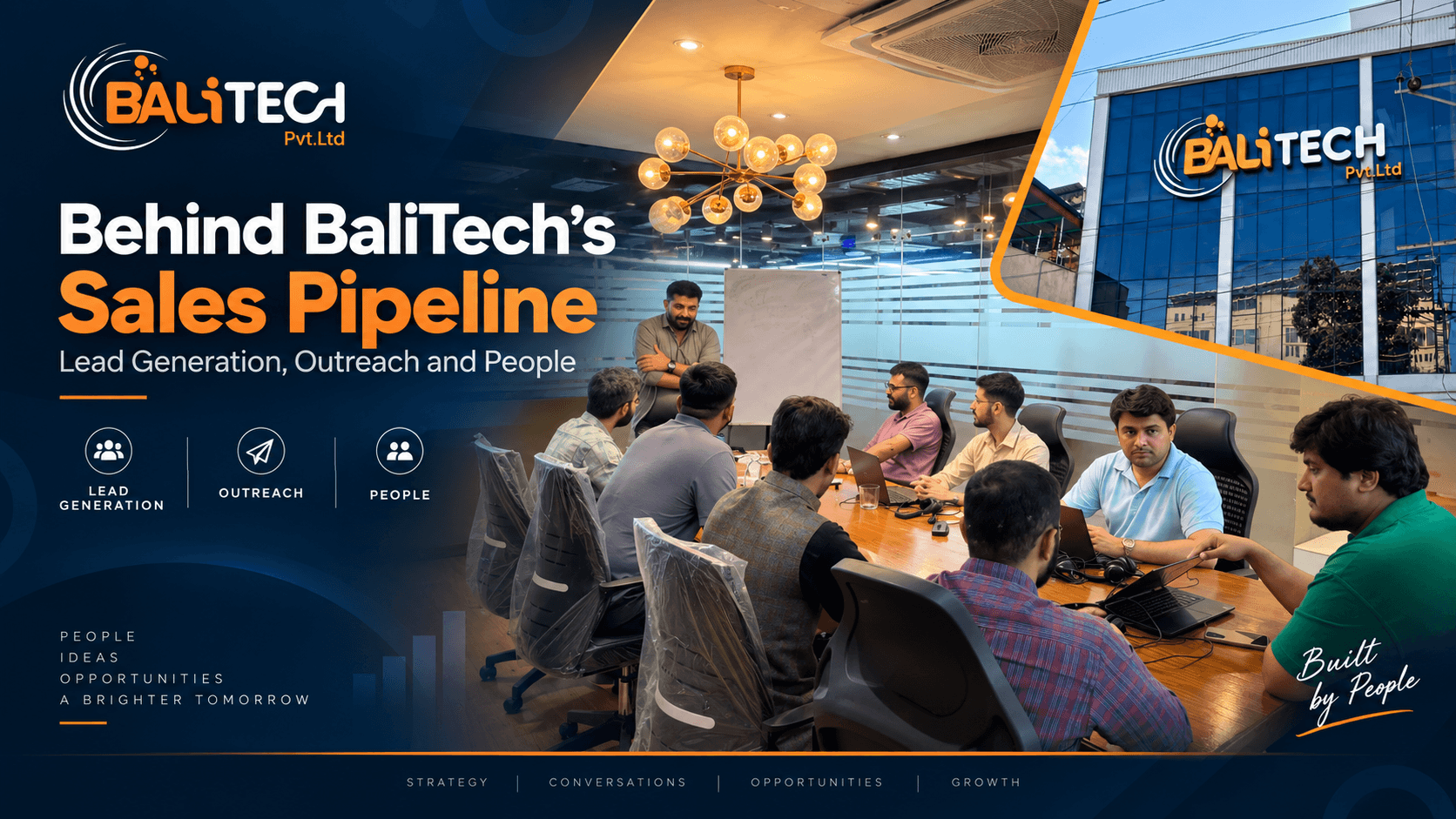
A qualified sales opportunity usually starts long before the closing conversation. This article looks behind BaliTech’s sales pipeline to show how prospect research, outreach, qualification, handoff, people and reporting work together.
A sales pipeline can look simple on a dashboard. A prospect appears, a conversation happens, an opportunity moves forward and eventually someone closes the sale. The reality behind that movement is usually much more detailed.
Before a salesperson speaks with a genuinely relevant prospect, somebody has normally done the work of identifying the right audience, researching the account, making first contact, understanding whether there is a real fit and deciding what should happen next.
That work is where lead generation services, B2B outreach, qualification, appointment setting and outbound sales begin to connect.
At BaliTech, those activities sit inside a wider BPO operation rather than functioning as isolated tasks. Research, outreach, qualification, handover, supervision, reporting and quality all have to work together if the sales team receiving the opportunity is expected to do something useful with it.
This is the part of the sales pipeline that is easy to overlook.
A lead is not valuable simply because someone answered the phone. A booked meeting is not automatically useful simply because it appears on a calendar. And a large contact list does not become a sales pipeline until there is a clear process for deciding which conversations deserve to move forward.
The Sales Pipeline Starts Before the First Conversation
Many people think lead generation begins when an agent starts calling.
In practice, it starts earlier.
The team first needs to understand who the business is trying to reach. That may mean defining industries, account types, locations, decision-maker roles or other qualification criteria that make sense for the campaign.
Without that foundation, outreach quickly becomes activity without direction.
Prospect research and list building are therefore not minor administrative steps. They shape the quality of every conversation that follows.
If the wrong companies are being contacted, a strong agent can still end up spending most of the day speaking with people who were never realistic prospects. If the correct accounts are identified but the outreach reaches the wrong person inside the organization, the result can be similar.
This is why a professional sales pipeline starts by getting the target clear before focusing on volume.
BaliTech’s lead generation services currently include prospect research and list building as part of campaign delivery, either working from client-provided data or building prospect lists around the agreed campaign setup.
Lead Generation Is About Relevance, Not Just Contact Volume
A lead generation campaign can look busy while producing very little value.
Calls may be made. Records may be updated. Contacts may respond. A report may show substantial activity.
The important question is what happens after contact.
Does the prospect match the audience the business actually wants? Is there a genuine need or relevant use case? Is the person being contacted in a position to influence or make a decision? Is there enough interest to justify handing the conversation to the sales team?
Those questions move the process from simple prospecting toward lead qualification.
For this reason, lead generation services should not be evaluated only by how many names or phone numbers enter a system. What matters more is whether the process creates conversations that the receiving sales team can realistically continue.
BaliTech’s current lead generation model is built around qualification criteria agreed with the client before handover. Leads that meet those criteria can then be passed through a warm transfer or scheduled handover, depending on the campaign structure.
That creates a clearer division of work. The lead generation team focuses on prospecting, contact and qualification, while the closer or sales team can spend more time on the part of the process where their experience is most valuable.
Qualification Protects the Sales Team’s Time
One of the most expensive mistakes in a sales pipeline is not necessarily failing to generate enough leads.
It is sending too many weak leads to the people responsible for closing.
A salesperson can only have a limited number of meaningful conversations during a working day. If a large part of that time is spent discovering that prospects do not meet basic campaign criteria, the pipeline may look active while the sales team becomes less productive.
Qualification exists to reduce that problem.
The exact criteria depend on the campaign. One business may care about company size. Another may need a particular type of decision-maker. In some cases, timing or need may matter. In others, the prospect may have to meet several requirements before the conversation should move forward.
There is no useful universal definition of a “qualified lead” that works for every campaign.
The criteria have to be agreed around the client’s actual sales process.
That is also why good lead qualification requires judgement rather than simply reading a script and ticking a box. Agents need to listen to the conversation, understand the campaign requirements and record the outcome accurately.
The stronger the qualification process, the more useful the handover becomes for the team that receives the lead.
Handover Is Where Lead Generation Meets Sales
Generating interest is only part of the job.
The next question is how that interest reaches the salesperson who needs to continue the conversation.
Some campaigns work well with a warm transfer. The prospect is qualified and, while interest is active, the conversation moves directly to the appropriate sales representative.
Other campaigns are better suited to a scheduled handover or appointment. The prospect agrees to speak at a particular time, giving both sides a clearer next step.
Neither method is automatically better.
The right handover depends on the campaign, the audience and the client’s own sales process.
What matters is that the handover is deliberate.
The sales team should know why the lead was passed forward, what information has already been collected and what happened during the earlier conversation. If the closer has to restart the entire qualification process from the beginning, much of the value of lead generation disappears.
BaliTech’s lead generation model supports both warm transfers and scheduled handovers, which gives businesses flexibility around how qualified opportunities enter their sales process.
Where Appointment Setting Fits Into the Pipeline
Appointment setting is often treated as though it is simply a matter of filling a calendar.
That is too narrow.
A useful appointment should represent a conversation worth having.
The prospect should be relevant. The right person should understand why the meeting is being arranged. The sales team should receive enough context to continue the discussion without confusion.
This makes appointment setting closely connected with qualification.
Booking more meetings without paying attention to relevance can create a calendar that looks impressive but produces weak sales conversations.
A more useful process works backwards from what the salesperson needs.
Who should be in the meeting? What does the prospect need to understand before agreeing to speak? What information should be collected before the appointment reaches the calendar? What should the sales representative know before joining the call?
Those questions make appointment setting part of the sales process rather than a separate activity measured only by booking count.
BaliTech’s outbound call center services include appointment setting alongside acquisition calling, follow-up and retention activity, allowing the function to sit within a larger outbound operation.
B2B Outreach Starts With the Right Account and the Right Person
B2B outreach changes the sales conversation because the team is selling into an organization rather than simply contacting an individual consumer.
That often means there are more people involved in the buying process.
The person who answers first may not be the person who can approve the purchase. The correct company may still be the wrong account if the product or service does not fit its needs. A relevant account may require several touches before the right conversation happens.
This is why B2B outreach usually begins with account selection and decision-maker identification.
The team needs to understand which businesses are being targeted and who inside those businesses is most relevant to the conversation.
From there, outreach may involve several contact attempts rather than a single cold call.
BaliTech’s B2B outreach services are structured around named account lists, decision-maker identification, multi-touch outreach and meeting booking. The process also includes pipeline reporting so the client can see what is happening across the accounts being worked.
This makes B2B outreach different from simply taking a broad list of contacts and dialing through it.
Lead Generation and B2B Outreach Are Related, but They Are Not the Same
The two functions often overlap because both are trying to create opportunities for a sales team.
The difference is usually found in how targeted the starting point is.
Lead generation can work with a wider pool of prospects and qualify people against agreed criteria before handing suitable opportunities forward.
B2B outreach tends to be more account-focused. The campaign may already know which companies it wants to reach, and the work becomes identifying the appropriate people inside those accounts, starting the conversation and moving relevant prospects toward a meeting.
That distinction matters because the operating process should match the sales strategy.
A business trying to discover new potential buyers may need broader lead generation. A company selling into a defined group of target accounts may need a more focused B2B outreach process.
Some campaigns need both.
The important part is not the label. It is whether the structure supports the way the client actually sells.
The People Behind the Pipeline Matter More Than the Tool
Sales technology receives a lot of attention, but the people using that technology still determine much of the quality of the process.
A CRM can store the record. A dialer can help organize calling activity. Reporting can show activity and outcomes.
None of those tools can decide whether an agent listened properly to the prospect.
They cannot automatically create judgement, communication skills or understanding of the campaign.
The people behind a lead generation operation need several different strengths.
Research requires attention to detail. Outbound conversations require confidence without sounding mechanical. Qualification requires listening. Appointment setting requires clarity around the next step. Verification requires accuracy. Supervisors need to understand both the numbers and the conversations behind those numbers.
This is why sales operations cannot be built around scripts alone.
A script may help keep the conversation structured, but the employee still needs to understand why each part of the process exists.
BaliTech’s wider operating model places trained teams, supervision, QA and reporting around live campaigns rather than leaving agents to work without a clear management layer. Businesses can see that broader structure on the BaliTech services page.
Supervision Keeps Activity Connected to the Campaign Goal
A sales floor can become busy very quickly.
When people are making calls, following up, booking meetings and updating records, activity is easy to see.
What is harder to see is whether the activity is moving in the right direction.
That is where supervision becomes important.
A supervisor needs to understand what the campaign is trying to achieve, where the team is struggling and whether the qualification process is being followed consistently.
If appointment numbers rise but the sales team reports that the meetings are weak, something needs to be investigated.
If agents are having many conversations but few prospects are moving forward, the issue may be the target list, the message, the qualification criteria or the campaign itself.
Good supervision connects the visible activity on the floor with the actual outcome expected from the client.
This is especially important in outsourced sales operations, where the client should not have to manage every individual agent directly.
Quality Assurance Has a Different Role in Sales Operations
Quality assurance is often associated with customer service or compliance, but it also matters in lead generation and outbound sales.
The goal is not simply to catch mistakes.
QA can help determine whether employees are following the agreed process, communicating accurately and qualifying prospects in the way the campaign requires.
If an agent is passing leads forward too easily, the closer may receive weak opportunities. If qualification becomes too strict, potentially useful prospects may be rejected before a sales conversation has a chance to develop.
This creates a balance that needs regular review.
Quality feedback can also reveal whether the problem belongs to one employee or whether several people are running into the same issue.
When the same objection or misunderstanding keeps appearing, the answer may involve changing training, clarifying the script or reviewing the campaign criteria.
This is one reason QA should sit inside the sales feedback loop rather than operate as a separate department that only produces scores.
Sales Verification Matters When the Process Requires More Control
Not every sales process ends when the salesperson gets agreement from the customer.
Some campaigns require a separate verification stage.
This is particularly important in regulated sales environments where the business may need documented confirmation that defined steps were followed.
Verification is different from prospecting and lead generation because the purpose is no longer to find the opportunity.
The purpose is to check the required information and complete the verification process accurately.
That work requires discipline. Approved wording may need to be followed. Outcomes need to be documented. Calls may need quality review.
BaliTech’s sales and verification services currently include script-based verification, documentation, audit trails and a separate quality review process for regulated campaigns.
That creates another example of how different teams can work around the same sales journey without performing the same job.
CRM Keeps the Pipeline From Becoming a Collection of Disconnected Conversations
A sales operation becomes difficult to manage if every employee keeps their own version of what happened.
One person remembers that a prospect asked for a callback. Another writes a note in a separate file. Someone else knows that an account was not interested six months ago. Eventually the team spends more time trying to understand the history than moving the opportunity forward.
This is why CRM discipline matters.
The CRM gives the team a shared working record.
It can show previous contact, outcomes, follow-up requirements and the current stage of the opportunity. Supervisors can use the information to understand the wider pipeline rather than relying only on verbal updates.
But a CRM is only useful when people enter information consistently.
Bad data simply creates a more organized version of confusion.
BaliTech’s campaign structure includes CRM and dialer configuration where required, connecting the technology layer with outbound calling, reporting and daily operations.
Conversion Tracking Closes the Feedback Loop
The lead generation team does not learn much if it never finds out what happened after handover.
A prospect may meet the initial qualification criteria and still fail to convert later.
That does not automatically mean the lead was poor. The sale may have been lost for several reasons.
But when the same pattern keeps repeating, conversion information becomes useful.
Perhaps one audience segment consistently performs better than another. Maybe one qualification question needs to be adjusted. A script may be creating interest but attracting the wrong type of prospect. One handover method may work better for a particular campaign.
That is why conversion tracking matters beyond reporting.
It gives the lead generation team information that can be used to improve targeting and conversations earlier in the process.
BaliTech’s current lead generation service includes tracking which leads convert so qualification criteria and scripts can be refined over time.
This is a healthier way to think about the pipeline.
The goal is not simply to keep feeding new names into the top.
The goal is to learn which types of opportunities are actually useful to the sales team.
Reporting Should Explain the Pipeline, Not Just Count Activity
A report can contain many numbers without answering the question management actually has.
How many calls were made is one piece of information.
How many conversations happened is another.
Neither tells the whole story.
For sales and lead generation operations, useful reporting should help the team understand movement through the pipeline.
Are the right accounts being reached? Are prospects meeting qualification criteria? Are meetings being booked with relevant people? Are handovers reaching the sales team with enough information? Are certain objections appearing repeatedly?
Those questions help managers improve the process.
BaliTech’s B2B outreach model includes pipeline reporting, while its broader campaign structure uses agreed metrics and reporting around the teams being managed.
The important principle is simple: the report should make the sales process easier to understand, not simply prove that people were busy.
What the Sales Team Should Still Own
Outsourcing lead generation does not mean outsourcing every part of the customer relationship.
In many campaigns, the client’s own sales team still owns the deeper commercial conversation.
That may include discovery, solution design, pricing, negotiation and closing.
The lead generation team supports that process by making sure the salesperson spends more time with people who have already passed the first stage of relevance and qualification.
This division can be especially useful when experienced salespeople are spending too much of their day researching contacts, making first-touch calls or repeatedly chasing prospects who were never a good fit.
The purpose of sales outsourcing is not always to replace an internal sales team.
It can also be used to support that team by moving repetitive prospecting and qualification work into a dedicated process.
Where BaliTech’s Sales Pipeline Fits Into the Wider BPO Operation
Lead generation does not sit alone inside BaliTech.
It connects with outbound calling, B2B outreach, appointment setting, sales verification, quality assurance, reporting and campaign technology.
That connection matters because each part of the process creates information that can improve another part.
Outbound agents hear objections from the market. Qualification shows which prospects are worth moving forward. Closers reveal which leads convert. QA identifies where conversations are becoming inconsistent. Reporting shows whether the campaign is moving in the expected direction.
A stronger pipeline develops when those pieces communicate with each other.
BaliTech’s broader BPO and call center service structure places management, quality, reporting and technology around the different campaign teams rather than treating each activity as an isolated service.
That is what turns lead generation from simple calling activity into part of an operating system.
Lead Generation From Rawalpindi and Islamabad
Rawalpindi and Islamabad have become important locations in BaliTech’s wider BPO operation.
The company currently operates physical offices across both cities and supports international campaigns from Pakistan.
This gives local searches such as BPO company Rawalpindi, BPO company Islamabad, call center in Rawalpindi and call center in Islamabad a real operational connection rather than simply being geographic keywords placed inside content.
Businesses comparing the best call center in Rawalpindi should also look beyond the number of agents or the size of the office.
For sales-focused campaigns, the more useful questions are how prospects are researched, how leads are qualified, how appointments are handed over, how performance is reported and whether feedback from the sales team is used to improve the campaign.
The same principle applies when evaluating any BPO or lead generation provider.
A strong sales pipeline depends less on how impressive the activity looks and more on whether the process consistently creates conversations the sales team can use.
The Human Skills Behind Lead Generation and B2B Sales
There is a reason lead generation remains a people-driven function even as technology becomes more capable.
A real conversation changes direction.
A prospect may ask something unexpected. They may sound interested but not meet the qualification criteria. They may have the right business need but not be the decision-maker. They may need a follow-up rather than an immediate appointment.
Employees need to listen and make sense of those situations while still working within the campaign process.
This creates career paths around more than basic cold calling.
Sales and BPO teams can involve prospecting, appointment setting, qualification, verification, QA, supervision, campaign management and technology-supported roles.
For people interested in sales, BPO or call center job opportunities, the exact positions available can change as campaigns change. Current BaliTech vacancies should therefore be checked through the official BaliTech Careers page rather than assumed from general information about the operation.
Why More Leads Is Not Always the Right Goal
It is natural for a business to want a larger pipeline.
The problem begins when the entire lead generation strategy is reduced to volume.
More records create more work. More conversations create more follow-up. More appointments take more time from the sales team.
If the additional activity is relevant, that can be valuable.
If it is not, the pipeline simply becomes harder to manage.
This is why quality and volume cannot be separated completely.
A lead generation operation needs enough activity to create opportunities, but it also needs standards that prevent weak prospects from moving forward simply to make the numbers look better.
The best sales pipeline is not necessarily the one with the most names in it.
It is the one where the next step is clear and the sales team trusts the opportunities being passed forward.
What Businesses Should Expect From a Lead Generation Partner
A business considering outsourced lead generation should first understand its own sales process.
The provider needs to know who the client wants to reach, what makes a prospect relevant, what information should be collected and what should happen after qualification.
There should also be clarity around reporting and handover.
If leads are being passed by warm transfer, the sales team needs to be ready to receive them. If appointments are being booked, calendars and follow-up expectations should be clear. If the campaign is targeting named B2B accounts, the team needs to understand which decision-makers matter.
Good outsourcing therefore begins with alignment.
The external team can manage prospecting and outreach, but it still needs to operate around the client’s actual sales process rather than a generic definition of what lead generation is supposed to look like.
Behind Every Qualified Lead Is a Process
A qualified lead may appear as one record inside a CRM, but the work behind that record can involve several people and several decisions.
Someone identified the prospect. Someone made contact. Someone understood whether the opportunity matched the criteria. The information had to be recorded. The conversation needed the right next step. The sales team needed enough context to continue.
B2B outreach adds another layer by making sure the team is speaking with the right people inside the right accounts.
Appointment setting gives the opportunity a defined next conversation.
Verification can add the control required in more structured sales environments.
Supervision, QA, CRM and reporting keep those activities connected.
That is the larger picture behind BaliTech’s sales pipeline.
The work is not simply about making more calls.
It is about creating a process in which research, outreach, qualification and people work together so that the sales team receives better opportunities and clearer information.
Businesses exploring this type of support can learn more about BaliTech’s lead generation services, B2B outreach services and wider outbound sales operations.
Frequently Asked Questions About Lead Generation and B2B Outreach
What are lead generation services?
Lead generation services help businesses identify, contact and qualify potential customers before suitable opportunities are handed to a sales team. The exact process can include prospect research, list building, outreach, qualification, appointment setting or warm transfer depending on the campaign.
What is B2B lead generation?
B2B lead generation focuses on creating sales opportunities with other businesses. The process usually involves identifying suitable companies, reaching relevant contacts, understanding whether there is a genuine fit and moving qualified prospects toward a sales conversation.
What is the difference between B2B outreach and lead generation?
Lead generation can qualify a broader pool of prospects, while B2B outreach is often built around defined account lists and specific decision-makers. Both can support the same sales pipeline, but the starting point and targeting process may be different.
What is lead qualification?
Lead qualification is the process of deciding whether a prospect meets the criteria agreed for the campaign. Those criteria can vary by business and may include need, timing, company profile, decision-making role or other requirements relevant to the sales process.
How does appointment setting fit into lead generation?
Appointment setting gives a qualified prospect a defined next step by scheduling a conversation with the appropriate salesperson or team. It works best when the prospect has been properly qualified and understands why the meeting is being arranged.
What is a warm transfer?
A warm transfer moves a qualified prospect directly from the lead generation conversation to the sales team while the prospect is still engaged. Whether this is suitable depends on the campaign and the way the client prefers to handle qualified opportunities.
Why is conversion tracking important in lead generation?
Conversion tracking helps the lead generation team understand which qualified leads eventually produce stronger sales outcomes. That information can be used to review targeting, scripts and qualification criteria over time.
How does CRM support a lead generation campaign?
CRM provides a shared record of prospect information, previous activity, outcomes and follow-up requirements. Consistent CRM use helps agents, supervisors and sales teams understand what has already happened and what should happen next.
Does BaliTech provide B2B outreach and appointment setting?
BaliTech’s current service offering includes B2B outreach built around named account lists, decision-maker identification, multi-touch outreach, meeting booking and pipeline reporting. Appointment setting is also included within its outbound call center operations.
Does BaliTech provide lead generation services?
Yes. BaliTech currently provides lead generation services that include prospect research and list building, qualification against agreed criteria, warm transfer or scheduled handover and conversion tracking.
Does BaliTech operate from Rawalpindi and Islamabad?
Yes. BaliTech currently operates physical offices across Rawalpindi and Islamabad and supports international BPO campaigns from Pakistan.
Where can I find current sales or call center jobs at BaliTech?
Current job opportunities should be checked through the official BaliTech Careers page. Open positions can change as campaigns and departments change, so the live careers section should be treated as the current source.